The short answer: Isaac Asimov wrote seven Foundation books: three in the 1950s, two sequels in the 1980s, and two prequels in the late 1980s and early 1990s. Three more were added after his death by other authors with the Asimov estate's blessing. Beyond those, eight of his Robot and Empire books connect to the same universe, which is how people arrive at the "15-book saga."
The number changes depending on what you mean by "Foundation book," so this page lists each group separately. If you want advice on which order to read them in, see the reading order guide. This page is the reference list.
The Seven Foundation Books by Isaac Asimov
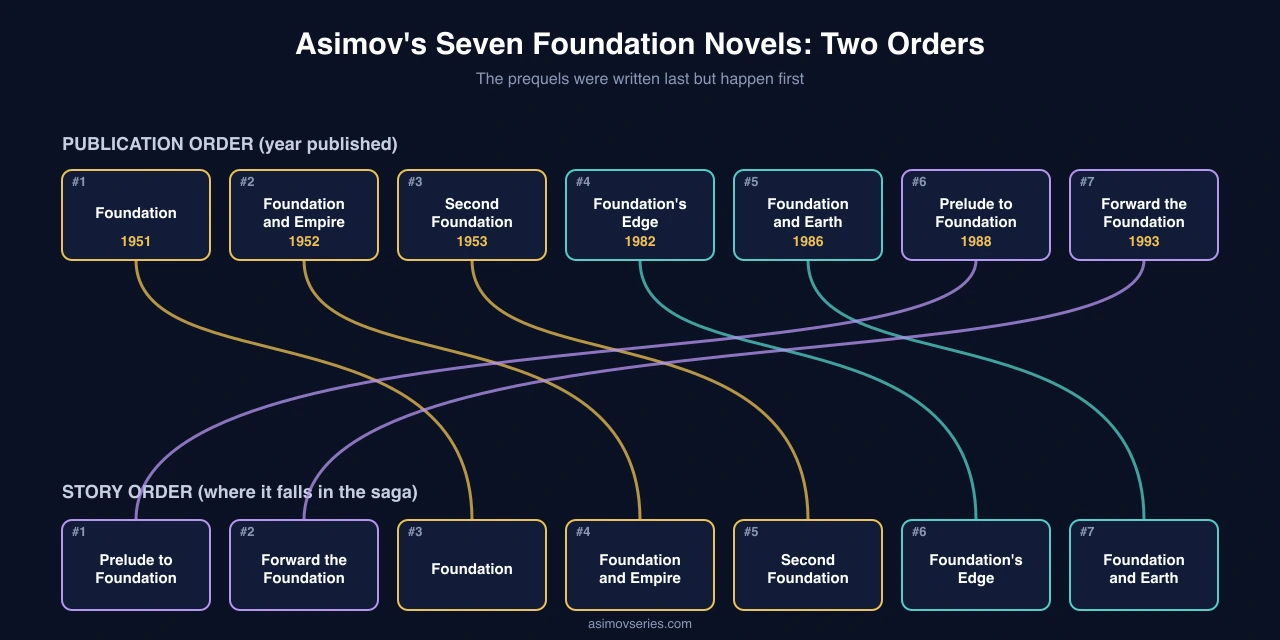
Listed in the order Asimov published them. Each entry also gives its "in-story order," meaning where it falls within the Foundation series itself, since the prequels were written last but happen first.
1. Foundation (1951) Five linked stories, first published as a single book by Gnome Press. Four had appeared in Astounding magazine between 1942 and 1944, and the opening section was written for the book. Hari Seldon founds the Foundation on Terminus, and the first Seldon Crises follow. In-story order: third.
2. Foundation and Empire (1952) Two novellas, both first published in Astounding in 1945. The second, "The Mule," won a Retro Hugo Award in 1996. The Foundation meets the Empire's last great general and then a mutant who was not in the Plan. In-story order: fourth.
3. Second Foundation (1953) Two novellas, first published in Astounding between 1948 and 1950. The search for the Second Foundation, the group Seldon placed at the other end of the galaxy. In-story order: fifth.
4. Foundation's Edge (1982) The first Foundation book in nearly thirty years, and the first written as a full-length novel. Golan Trevize and Janov Pelorat go looking for Earth and find Gaia. It won the Hugo Award for Best Novel in 1983. In-story order: sixth.
5. Foundation and Earth (1986) Trevize and Pelorat continue the search for Earth, and the Foundation series meets the Robot novels. In-story order: seventh, the last chapter of the saga.
6. Prelude to Foundation (1988) A younger Hari Seldon arrives on Trantor and begins to work out psychohistory. In-story order: first.
7. Forward the Foundation (1993) Seldon's last decades and the creation of both Foundations. Published posthumously, about a year after Asimov's death on April 6, 1992. In-story order: second.
Put in story order instead, the seven read: Prelude, Forward, Foundation, Foundation and Empire, Second Foundation, Foundation's Edge, Foundation and Earth.
Three Foundation Books by Other Authors
After Asimov's death, the Asimov estate authorized a trilogy of new novels set during Hari Seldon's lifetime. It is usually called the Second Foundation Trilogy, and each book is by a different author:
- Foundation's Fear (1997) by Gregory Benford
- Foundation and Chaos (1998) by Greg Bear
- Foundation's Triumph (1999) by David Brin
These are set in the same period as Prelude and Forward, and fans generally treat them as an extra rather than part of the core canon. If you count them, the number of "Foundation books" is ten.
The Eight Connected Books (Robot and Empire)
Asimov did not set out to build one universe. The Robot novels, the Empire novels, and the Foundation books were written as separate series, and he linked them in the 1980s. These eight books are the ones that connect directly to the Foundation story:
The Robot novels
- The Caves of Steel (1954), with detective Elijah Baley and the robot R. Daneel Olivaw
- The Naked Sun (1957)
- The Robots of Dawn (1983)
- Robots and Empire (1985), the bridge between the Robot and Foundation eras
The Empire novels
- Pebble in the Sky (1950)
- The Stars, Like Dust (1951)
- The Currents of Space (1952)
One story collection
- I, Robot (1950), nine linked stories that introduce the Three Laws of Robotics
Add these eight to the seven Foundation novels and you get the 15-book saga that many fans mean when they talk about "reading the whole thing." The Robot novels are not Foundation books by title, but they are the origin of the character who connects everything, R. Daneel Olivaw, and of the Three Laws that still get argued about in AI.

Common Points of Confusion
"Foundation" is a book, a trilogy, and a series. The first book is called Foundation. The first three books together are the Foundation Trilogy. The seven Asimov novels together are the Foundation series. The trilogy as a set received the one-off Hugo Award for "Best All-Time Series" in 1966, and Foundation's Edge later won the regular Best Novel Hugo in 1983.
The original books are not novels in the usual sense. Three of the seven are assembled from earlier magazine stories, which is why each one jumps forward in time by decades. The later four are conventional novels.
Publication order is not story order. The two prequels, Prelude and Forward, were written last and happen first. This is the main reason readers ask which book to open first.
The TV series is not the books. Apple TV+'s Foundation uses the characters and the setting but changes a great deal, including major plot points. For a book-by-book comparison, see Foundation Books vs the TV Show.
Which Count Should You Use?
- "How many Foundation books did Asimov write?" Seven.
- "How many Foundation books exist in total?" Ten, if you include the three by Benford, Bear, and Brin.
- "How many books do I need to read the whole story?" Fifteen, counting the Robot and Empire books that Asimov connected to the series.
- "How many do I need to follow the TV show?" There is no required number. The first three books are the closest source for the early seasons, and the later seasons draw on the sequels as well.
If you are starting out, the original three are short and work on their own. From there, the reading order guide lays out the main routes through the rest, and our reading path tool builds one for you.
Frequently Asked Questions
What is the first Foundation book? Foundation (1951) is the first one published. If you read in story order, Prelude to Foundation (1988) comes first.
What is the last Foundation book? Forward the Foundation (1993) is the last one Asimov wrote and the last one published under his name. In story order, the last chapter is Foundation and Earth (1986).
Is I, Robot part of the Foundation series? No. It is a story collection in the Robot series. It connects to the Foundation story only through the characters and ideas that Asimov later linked, which is why it appears in the 15-book saga but not among the seven Foundation novels.
Do I need to read the Robot books before Foundation? No. The Foundation Trilogy stands alone, and many readers start there. The Robot books matter more for Foundation and Earth, where the two series meet.
Are there other books set in the Foundation universe? Yes. Besides the Second Foundation Trilogy, there are further unofficial works by other writers. This page sticks to Asimov's own books and the estate-authorized trilogy.