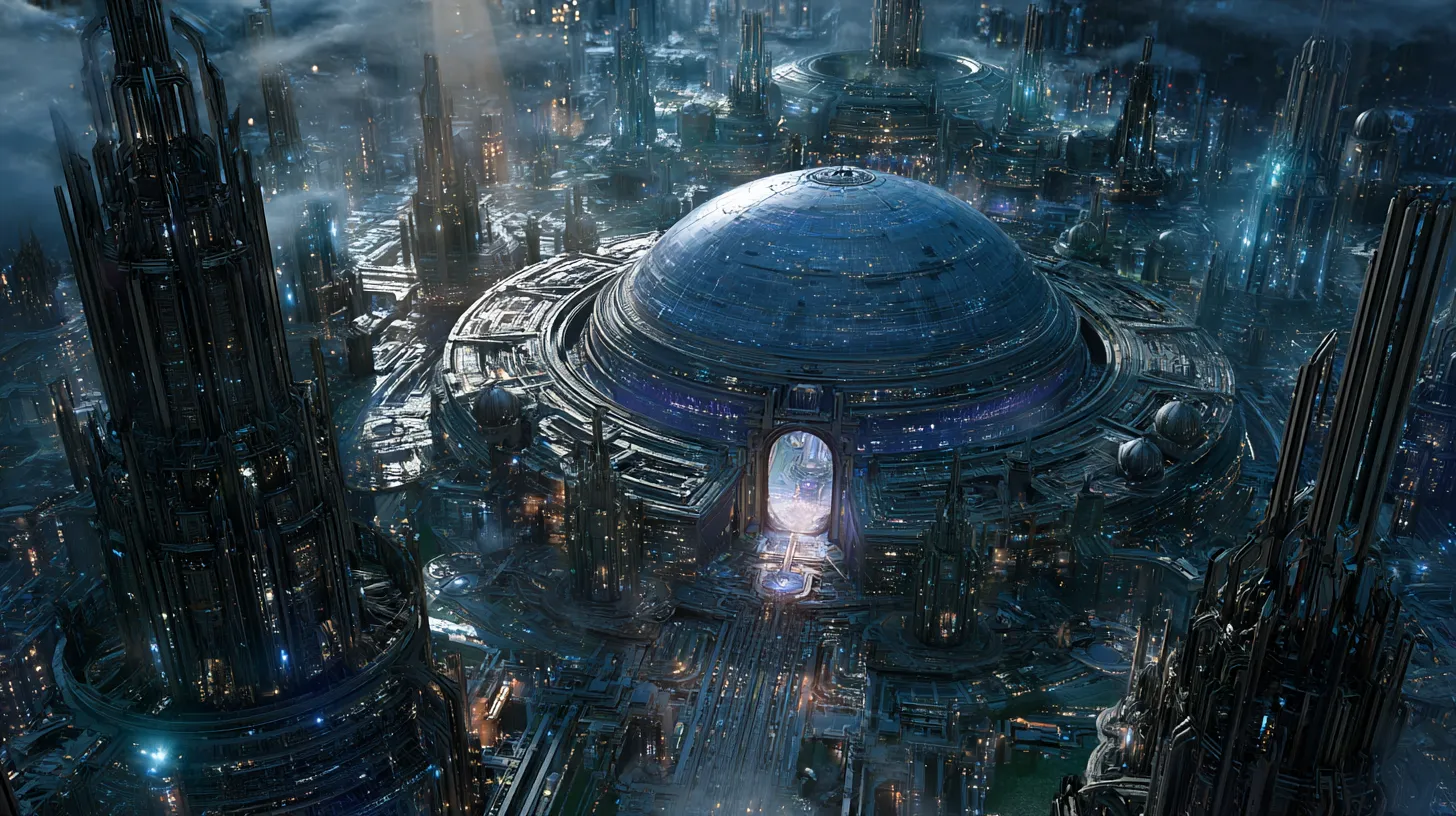
The Caves of Steel
by Isaac Asimov
The Caves of Steel (1954) is a science fiction murder mystery introducing detective Elijah Baley and robot partner R. Daneel Olivaw. Set on a claustrophobic, domed Earth, they investigate the murder of a Spacer ambassador while navigating deep anti-robot prejudice.
Published
1954
Pages
206
Pub. Order
#9
Chron. Order
#2
Synopsis
In a future where Earth's population lives in massive enclosed Cities — the 'caves of steel' — detective Elijah Baley is assigned to investigate the murder of a Spacer ambassador. His partner is R. Daneel Olivaw, a humanoid robot so advanced he is indistinguishable from a human.
The investigation forces Baley to confront his own anti-robot prejudice as he and Daneel form an unlikely partnership. The mystery also exposes the deep tensions between Earth's crowded, agoraphobic population and the wealthy, robot-dependent Spacer worlds.
Reader's Guide
How the Book Is Built
The Caves of Steel was serialized in Galaxy from October to December 1953 and published as a book in 1954. Asimov wrote it because the editor Horace Gold argued that science fiction and fair-play mystery could not be combined. Asimov set out to prove him wrong.
The setting is Earth, a few thousand years from now. Its eight billion people live in vast enclosed Cities and rarely go outside. The Spacers, descendants of Earth's early colonists, live on fifty rich worlds with few people and many robots, and they keep a small enclave, Spacetown, next to New York City. When a Spacer scientist is murdered there, New York detective Elijah Baley is assigned to the case, with a Spacer partner: R. Daneel Olivaw, a robot built to look exactly human.
What to Watch For
A real mystery. Asimov gives the reader all the clues. The rules of the world, especially the Three Laws of Robotics, constrain who could have done what. Readers who like to solve along will enjoy the book most.
Baley's prejudice. Baley starts out distrusting robots and resenting Spacers, like most people on Earth. His partnership with Daneel, and his gradual respect for him, is the emotional core of the book and of the whole series that follows.
Life in the City. The details of the Cities, with their communal kitchens, strict rationing, moving expressways, and residents' fear of open sky, are some of Asimov's best worldbuilding. They also set up a question the later novels keep asking: what would it take for Earth's people to leave?
The C/Fe idea. One Spacer character argues for a culture combining humans and robots, carbon and iron. Keep it in mind; it matters in the sequels.
Where It Fits and Who It's For
This is the first Robot novel and the best entry point to the Robot series. It works entirely on its own. You do not need to have read I, Robot, though knowing the Three Laws helps.
It matters for the Foundation series too. R. Daneel Olivaw, introduced here, becomes one of the most important characters in Asimov's entire future history, and he returns in Prelude to Foundation and Foundation and Earth.
Spoiler note: summaries online often give away the killer. If you want to solve it yourself, avoid them.
On Screen
There is no major adaptation. The BBC made a television version in 1964 for its Story Parade series, but most of it is lost.
Key Themes
Key Characters
R. Daneel Olivaw
Humanoid robot detective who becomes humanity's greatest protector
Historical Context & Writing Background
Asimov wrote this at the suggestion of editor Horace Gold, who challenged him to combine science fiction with detective fiction. The result was published by Doubleday) and became one of the first successful genre mashups in SF. R. Daneel Olivaw, introduced here, would become one of Asimov's most important characters, appearing across the entire Foundation universe.
Critical Reception
Praised for successfully blending science fiction with mystery. The Baley–Daneel partnership is considered one of the great literary relationships in SF, as noted by the Encyclopedia of Science Fiction. The novel remains highly readable and is often recommended as an entry point to Asimov's work.
Connection to Asimov's Universe
This novel introduces R. Daneel Olivaw, who goes on to become the hidden architect of all galactic history in 'Foundation and Earth.' The Baley–Daneel partnership continues in 'The Naked Sun,' 'The Robots of Dawn,' and 'Robots and Empire.'
Read more on WikipediaFrequently Asked Questions About The Caves of Steel
What are the Caves of Steel?
The 'caves of steel' are the massive enclosed Cities where billions of Earthpeople live in the future. Agoraphobia has become so prevalent that most humans never see the sky. These steel-enclosed mega-cities are a metaphor for humanity's retreat from the natural world and its resistance to change.