Foundation
by Isaac Asimov
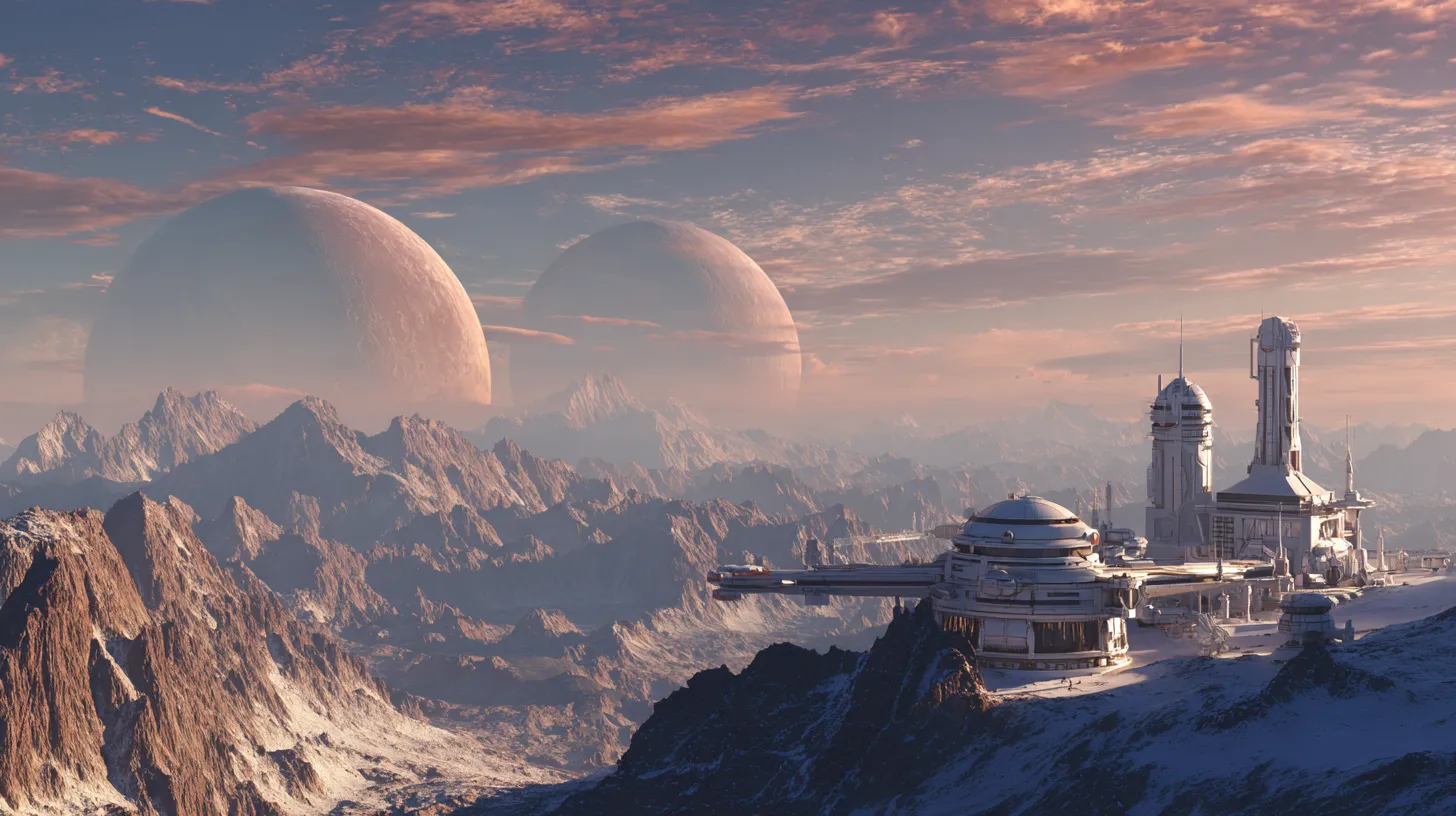
Foundation (1951) is the first novel in Isaac Asimov's Foundation series. It chronicles the establishment of the Foundation on Terminus and its survival through the first three Seldon Crises as the Galactic Empire collapses around it.
Published
1951
Pages
244
Pub. Order
#1
Chron. Order
#10
Recognition & Milestones
Hugo Award for Best All-Time Series (1966)
Synopsis
Mathematician Hari Seldon has developed psychohistory, a new field of science that allows him to predict the future of large populations. He foresees the inevitable collapse of the 12,000-year-old Galactic Empire and a subsequent dark age lasting 30,000 years. To shorten this period to just 1,000 years, Seldon establishes two Foundations, said to be at 'opposite ends of the galaxy' — a phrase the trilogy later turns into a twist.
The novel follows the First Foundation on the remote planet Terminus through its first 150 years. The Foundation survives a series of predictable crises — later called 'Seldon Crises' — each of which has only one possible solution. Under leaders like Salvor Hardin and Hober Mallow, the Foundation uses religion, trade, and economic leverage rather than military force to dominate the surrounding kingdoms that emerge from the Empire's ruins.
The book has five sections: four stories first published in Astounding Science Fiction between 1942 and 1944, plus a new opening section, 'The Psychohistorians', written for the 1951 book edition. Each story jumps forward in time, introducing new characters who must navigate the next crisis in the Seldon Plan.
Reader's Guide
My Take
I first read Foundation about ten years ago, in Chinese translation. To be honest, the opening, with Seldon arriving on Trantor, didn't do much for me. I kept going anyway, and the further I read, the harder it was to stop. I read the entire Foundation series in one go, then went looking for every Asimov novel I could find. About two years ago I reread the whole saga from start to finish, and that is when I found out about the TV series and started following it.
What stayed with me from that first read was the scale. In both time and space, Foundation builds an enormous world; to me it is a science fiction epic without equal. And psychohistory fascinated me from the very first pages.
— Jason Guo, editor
How the Book Is Built
Foundation is not a novel in the usual sense. It is five linked stories covering about 150 years, and each one jumps forward in time with a new cast. Four of them first appeared in Astounding Science Fiction between 1942 and 1944. The fifth, the opening section, was written for the 1951 book edition to explain how it all started.
- The Psychohistorians (year 0; written for the 1951 book): Gaal Dornick and Hari Seldon
- The Encyclopedists (about 50 F.E.; Astounding, May 1942, as "Foundation"): Salvor Hardin
- The Mayors (about 80 F.E.; June 1942, as "Bridle and Saddle"): Salvor Hardin
- The Traders (about 135 F.E.; October 1944, as "The Wedge"): Limmar Ponyets
- The Merchant Princes (about 155 F.E.; August 1944, as "The Big and the Little"): Hober Mallow
Knowing this helps with the book's quirks. Each story re-explains the setting a little, because magazine readers needed it. Characters rarely carry over. And the pace is set by conversation, not action: almost every crisis is resolved by someone talking, bargaining, or waiting.
What to Watch For
The obvious move. Every section's hero wins by seeing what the situation actually demands while everyone around them argues about something else. Hardin notices that the Board of Trustees is waiting for a rescue that will not come. Ponyets notices that a greedy official can be bought. Mallow notices that no one on Korell can fix a broken appliance. Asimov's point is that Seldon's crises are solved by the only reasonable choice, and it takes a clear head to see it.
The Time Vault. Seldon's recorded appearances are the book's heartbeat. Each time the vault opens, the reader gets to check the characters' reasoning against Seldon's, and the gap between what people feared and what Seldon calmly expected is the source of much of the book's quiet humor.
Power without violence. The Foundation moves from science to religion to trade, and never really to war. "Violence is the last refuge of the incompetent" is not just Hardin's line; it is the book's method. Notice how often a threatened battle simply does not happen.
The Empire offstage. Trantor dominates the first section and then almost disappears. By the last story, Mallow has to go looking for evidence that the Empire still exists at all. That shrinking is the fall of the Empire, told from the edge.
Where It Fits and Who It's For
In publication order, this is where you start: Foundation came first, and the later books assume you know what psychohistory is and why Seldon matters. In chronological order, which is how I read the saga, it comes right after the two prequels, and Seldon's trial reads as the payoff of everything before it. Either way, if you enjoy the problem-solving and the dry wit, read on into Foundation and Empire, where the formula is tested to destruction. If you want character-driven drama and big action, expect to be patient; the payoff of this book is the idea, not the people.
It is short (about 250 pages) and quick to read. The most common stumbling block is the constant reset of characters; it helps to treat each section as its own story about the same institution.
On Screen
The Apple TV+ series draws on this book's names and outline rather than its plots. Season 1 uses the Psychohistorians and the Encyclopedists as a skeleton: Gaal, Seldon's trial, the exile to Terminus, Salvor Hardin, and Anacreon. Season 2 borrows Poly Verisof, Hober Mallow, and Korell. Almost everything else, including Seldon's murder, the Vault's mysterious field, and the cloned emperors, is new.
Key Themes
Historical Context & Writing Background
Asimov was inspired by Edward Gibbon's The History of the Decline and Fall of the Roman Empire (1776). As he recounted in his autobiography In Memory Yet Green (1979), he conceived the idea during a subway ride to meet editor John W. Campbell on August 1, 1941. The original short stories were published in Astounding Science Fiction magazine from May 1942 to October 1944, then collected into a novel by Gnome Press in 1951.
Critical Reception
The Foundation trilogy won the Hugo Award for 'Best All-Time Series' in 1966, defeating J.R.R. Tolkien's 'The Lord of the Rings.' According to the Encyclopedia of Science Fiction, Foundation is consistently ranked among the greatest science fiction novels ever written. It has influenced generations of writers, scientists, and entrepreneurs — including Elon Musk, who cited Foundation as an inspiration for SpaceX, Nobel laureate Paul Krugman, and former US Speaker Newt Gingrich.
Connection to Asimov's Universe
Foundation is the publication-order starting point of the saga, though the later prequels are set before it. Events here take place roughly 20,000 years after the Robot novels and thousands of years after the Empire novels. The Seldon Plan established here drives the plot of all subsequent Foundation novels.
Read more on WikipediaFrequently Asked Questions About Foundation
What is Foundation by Isaac Asimov about?
Foundation is about mathematician Hari Seldon's plan to preserve human knowledge and shorten a predicted 30,000-year dark age to just 1,000 years. He establishes the Foundation on the remote planet Terminus, which then navigates a series of political crises as the Galactic Empire collapses. The novel explores how small groups can use science, religion, and economics to shape the course of history.
Is Foundation hard to read?
Foundation is relatively accessible compared to other classic science fiction. At 244 pages, it reads quickly. The main challenge is its episodic structure — each section jumps forward decades with new characters. However, the overarching narrative provides a compelling thread. Most readers find the ideas more engaging than any individual character.
What order should I read the Foundation series?
There are two good answers. Chronological order, which the editor recommends, starts with Prelude to Foundation (1988) and Forward the Foundation (1993), then Foundation, Foundation and Empire, Second Foundation, Foundation's Edge, and Foundation and Earth. Publication order, which many long-time fans prefer because it preserves Asimov's surprises, starts with Foundation (1951), Foundation and Empire (1952), Second Foundation (1953), then the sequels Foundation's Edge (1982) and Foundation and Earth (1986), and finally the prequels Prelude to Foundation (1988) and Forward the Foundation (1993). The Apple TV+ series (2021–2025) follows its own continuity.
Did Foundation win the Hugo Award?
Yes. In 1966, the original Foundation trilogy won a special Hugo Award for 'Best All-Time Series,' beating J.R.R. Tolkien's 'The Lord of the Rings.' This remains one of the most significant awards in science fiction history.
What inspired Asimov to write Foundation?
Asimov was inspired by Edward Gibbon's 'The History of the Decline and Fall of the Roman Empire.' He conceived the idea of applying Gibbon's historical analysis to a future galactic civilization during a subway ride to meet his editor John W. Campbell on August 1, 1941.