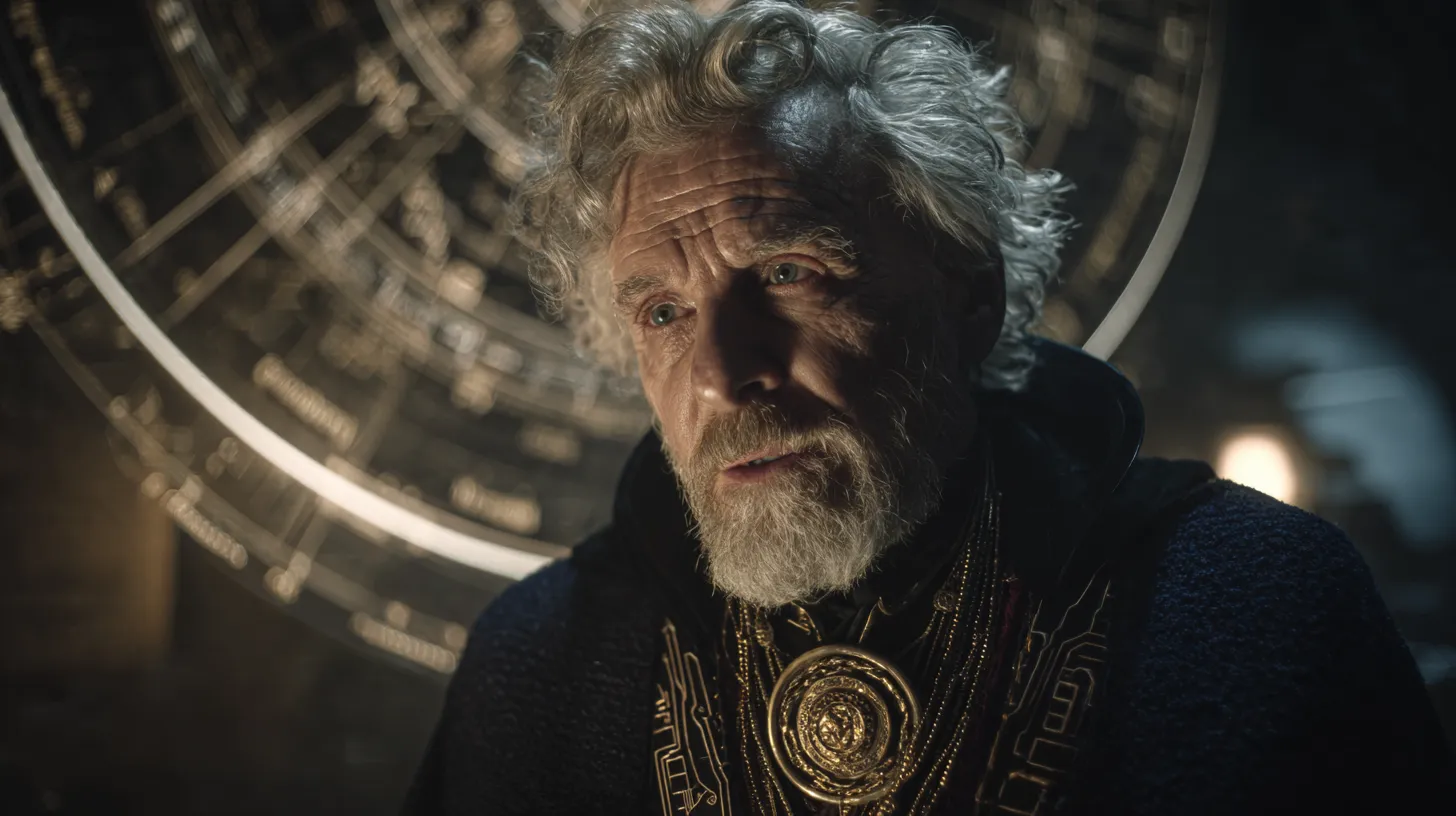
Hari Seldon
The mathematician who developed psychohistory and founded both Foundations to preserve civilization.
Quick Summary
Hari Seldon is the creator of psychohistory in Isaac Asimov's Foundation series. He predicted the Galactic Empire's fall and established two Foundations to shorten the subsequent dark age from 30,000 years to just 1,000.
Last updated: 2026-09-23
Appears In
- Prelude to Foundation
- Forward the Foundation
- Foundation
Key Traits
- Mathematician
- Psychohistorian
- First Minister
- Founder
Importance
Creator of Psychohistory in the Foundation saga
My Take
I prefer the Seldon of the books. To me, Jared Harris's Seldon never quite captures the spirit of the character on the page. The Seldon moment I remember best is the first time his recording appears in the Time Vault, in Foundation. It's a stunning scene.
— Jason Guo, editor
Hari Seldon is the most important character in Isaac Asimov's Foundation universe who never gets to be the hero of his own story. He appears in person in only three books: the prequels Prelude to Foundation and Forward the Foundation, and the opening section of Foundation. After that he returns only as a recording in the Time Vault. Yet his shadow falls across every page of the series. Every crisis the Foundation faces is a crisis he anticipated. Every decision the Foundation makes is shaped by a plan he laid down centuries before the characters were born.
He is, in the language of the series itself, the man who engineered the future.
But Seldon is not a simple visionary. He is a mathematician who doubted his own equations, a politician who never wanted power, and a man who sacrificed his personal happiness, and ultimately his life, for a theory he wasn't sure would work. Understanding Hari Seldon means understanding the tension at the heart of the Foundation series: the conflict between mathematical determinism and human free will, between the plan and the people who must live inside it.
Early Life and Origins
Hari Seldon was born on the planet Helicon, a relatively minor world of the Galactic Empire, known mainly for its martial art of "twisting" and its unremarkable, provincial culture. Helicon was located in a remote sector of the galaxy, far from the political center of Trantor. It was, in every way, the kind of place that produces provincial thinkers, not galactic revolutionaries.
Asimov tells us little about his childhood beyond a modest family background. What set Seldon apart was mathematical talent, and by his early thirties he was a respected but obscure mathematician from the provinces.
Asimov reveals these details gradually across Prelude to Foundation (1988) and Forward the Foundation (1993), the two prequel novels he wrote near the end of his life. The young Seldon is not a prodigy who knows he will change the galaxy. He is a talented mathematician who wants to do good work, earn tenure, and live a quiet academic life. The revolution he will eventually lead is, at this stage, entirely beyond his imagination.
This matters for the character. Seldon's greatness is not innate destiny; it is the product of circumstance, mentorship, and a series of decisions he makes under pressure. Asimov was deliberately rejecting the "chosen one" narrative that dominates so much science fiction and fantasy. Hari Seldon is not a prophet born to save civilization. He is a man who stumbles into the realization that civilization can be saved, and then decides that he is the one who has to try.
The Flight Across Trantor (around 12,020 G.E.)
The turning point in Seldon's life occurs at the Decennial Convention on Trantor, the imperial capital, where he presents a paper on the theoretical possibility of predicting social trends through mathematical modeling. The paper is speculative, and Seldon himself insists it is only a theoretical possibility, but it draws the attention of Emperor Cleon I and his chief minister, Eto Demerzel, who see a potential tool for propaganda.
Demerzel, who is secretly the robot R. Daneel Olivaw operating under a human alias (see our complete guide to R. Daneel Olivaw), recognizes that Seldon's theory could be the tool he has been seeking for millennia: a mathematical framework that could guide human civilization without requiring a hidden robot guardian. Wearing yet another face, the journalist Chetter Hummin, Daneel warns Seldon that he is in danger and sends him on the run across Trantor, keeping him out of reach of the Emperor and of rivals like the rulers of Wye, while steadily pushing him to make psychohistory practical.
What follows is the adventure at the heart of Prelude to Foundation. Seldon, fleeing imperial agents, travels across the diverse sectors of Trantor: each one a self-contained world with its own culture, economy, and social structure. He visits:
- Mycogen: A closed, religiously fundamentalist sector that preserves ancient records and claims descent from the original Spacer worlds
- Dahl: A working-class sector where Seldon meets Yugo Amaryl, the brilliant young mathematician who will become his closest collaborator
- Wye: A powerful sector whose ruling family, led by the ambitious Rashelle, wants Seldon as a political weapon
This journey is not just an adventure narrative. It is the practical education that transforms Seldon's abstract mathematics into a workable science. By observing how different sectors of Trantor, each with distinct populations, traditions, and economic systems, exhibit predictable social patterns, Seldon begins to understand that his theoretical equations might actually describe something real.
His companion throughout is Dors Venabili, a historian at Streeling University who is assigned to protect him and who will become his wife. She pushes the mathematician to take history seriously as data. By the end of the novel Seldon believes he can see a way to make psychohistory work, and Hummin reveals that he is both Demerzel and the robot R. Daneel Olivaw.
This is the moment psychohistory becomes more than a thought experiment. Not in a flash of genius, but through the collision of mathematical talent with the variety of real societies, seen up close.
The Development of Psychohistory (Forward the Foundation)
Forward the Foundation covers the next four decades of Seldon's life, as he transforms psychohistory from a theoretical possibility into a working predictive science. The process is agonizing.
From his base at Trantor's Streeling University, where he later also serves as the Emperor's First Minister, Seldon assembles a team: Yugo Amaryl, the Dahl-born prodigy; Dors Venabili, who becomes both his intellectual partner and his wife; and later, a succession of assistants who each contribute pieces to the puzzle.
The technical challenge is immense. Psychohistory requires:
-
A population large enough for statistical regularities to emerge: Asimov specifies that the population must be in the billions, ideally the quadrillions that make up the Galactic Empire. Individual behavior is unpredictable; aggregate behavior follows patterns.
-
A model of how social variables interact: economic conditions, political structures, technological change, cultural traditions, and demographic shifts all influence each other in feedback loops that are extraordinarily difficult to formalize.
-
Historical data sufficient to calibrate the model: Seldon's team spends years mining the imperial archives, building datasets that span thousands of years of galactic history.
-
Computational power to run the equations: in Asimov's universe, this means the Empire's most advanced computing systems, which Seldon gains access to through his political connections.
The breakthroughs come slowly, and each one is paid for in a different currency. Yugo Amaryl works himself to an early death, sacrificing his health to the equations. Dors Venabili, who is secretly a robot tasked with protecting Seldon (another of Daneel's arrangements), suppresses her own nature to serve as Seldon's partner. Seldon himself ages prematurely under the strain, watching his colleagues die while he pushes forward.
Asimov portrays the creation of psychohistory not as a heroic triumph but as a slow accumulation of sacrifices. Every advance costs something: a colleague's health, a friendship, a piece of Seldon's own humanity. By the time psychohistory is functional enough to make real predictions, Seldon is an old man who has outlived most of the people he loved.
This is one of the most honest depictions of scientific work in science fiction. Real breakthroughs are not eureka moments. They are years of grinding effort, false starts, and personal cost. Asimov, who was himself a professional scientist (a professor of biochemistry at Boston University), knew this intimately. He gave Seldon the life of a real researcher: not a glamorous one, but a meaningful one.
The Prediction and the Seldon Plan
Once psychohistory becomes functional, it delivers its first and most devastating prediction: the Galactic Empire will fall, and the collapse is irreversible. No political reform, no military campaign, no technological breakthrough can prevent it. The decay is too deeply embedded in the Empire's structure: bureaucratic calcification, declining innovation, economic stagnation, and the sheer complexity of governing 25 million worlds.
At his trial he puts it bluntly: Trantor will lie in ruins within three centuries. After the collapse, humanity will endure 30,000 years of barbarism before a new galactic civilization emerges.
Seldon's response to this prediction is the Seldon Plan: the most ambitious engineering project in the history of fiction. Instead of preventing the fall (which psychohistory says is impossible), he will shorten the dark age. By establishing two Foundations at opposite ends of the galaxy, each preserving scientific knowledge and guiding civilization through predicted crises, the 30,000 years of barbarism can be reduced to 1,000 years.
The plan depends on a series of "Seldon Crises": predictable turning points at which the Foundation will face a specific threat, and at which a specific course of action will be optimal. Seldon records holographic messages in advance, to be played at the Vault on Terminus at the appropriate moment. Each message explains the crisis and confirms that the Foundation has been guided to the correct response.
The elegance of the plan is that it doesn't require the Foundation to know the full plan. The Foundation's leaders only need to respond to each crisis as it arises. The plan works through them, using their self-interest and ingenuity as the mechanism for its execution. Seldon doesn't need to control the future: he needs to shape the conditions under which free people, acting in their own interest, will make the choices that lead to the outcome he predicted.
This is the deepest idea in the Foundation series, and it's worth pausing on. Seldon's plan is not a blueprint that dictates every action. It is a framework that shapes the probability space in which actions occur. The Foundation's leaders believe they are making independent choices, and they are. But Seldon has arranged the board so that the choices they are likely to make, given who they are and what they value, are the choices that move the plan forward.
The question the series ultimately asks is whether this is freedom or manipulation, and whether the distinction matters if the outcome is the survival of civilization.
The Trial and Exile
The imperial establishment's response to Seldon's prediction is predictable: denial, anger, and suppression. In the opening chapters of the original Foundation (1951), Seldon is tried for treason by the Commission of Public Safety, led by Linge Chen.
The trial is a masterpiece of political theater. Seldon doesn't deny that he predicted the fall of the Empire. Instead, he presents his work as mathematics rather than politics. He argues that his predictions are probabilities, not certainties, and that the Empire's own attempts to suppress his work are more dangerous to stability than his theories.
The Commission, unable to execute a man whose only crime is mathematics but unwilling to let him continue freely, settles on exile. Seldon and his followers are sent to Terminus, a remote planet at the edge of the galaxy. This is exactly what Seldon wanted. Terminus becomes the home of the First Foundation, and its isolation from the political center is precisely what allows it to survive the Empire's collapse.
The trial scene is important because it establishes Seldon's political skill. He is not merely a mathematician; he is a strategist who understands how to manipulate institutions to achieve his goals. He provokes the trial knowing that the outcome will be exile, not execution, because the Commission cannot afford the political cost of killing a popular scientist. He plays the system with the same precision he applies to his equations.
This is a side of Seldon that the TV series has emphasized more than the books. In the Apple TV+ adaptation, Seldon (played by Jared Harris) is openly political, a man who understands that mathematics without political action is useless. His confrontation with the Empire is not passive; it is a calculated challenge designed to produce a specific outcome. The show captures something that was implicit in Asimov's writing: Hari Seldon was not just a scientist. He was a man who decided to save civilization, and then did whatever was necessary to make that happen.
The Encyclopedia Galactica and the First Foundation
On Terminus, Seldon establishes the Encyclopedia Galactica project, a massive effort to compile all human knowledge into a single reference work. The stated purpose is preservation: when the Empire falls, much of its scientific and cultural knowledge will be lost. The Encyclopedia will serve as a bridge, carrying that knowledge through the dark age to the civilization that emerges on the other side.
The real purpose is different. The Encyclopedia project is a cover story. It gives the Foundation a mission that the Empire can tolerate (compiling an encyclopedia is harmless) and that will attract the kind of people Seldon needs: scientists, engineers, and scholars who value knowledge above politics. These people will become the nucleus of the Foundation's scientific community, which will eventually develop technologies that give the Foundation economic and military leverage over the surrounding barbarian kingdoms.
Seldon reveals this in his first recorded message, played in the Time Vault about fifty years after the Foundation's founding. The Encyclopedia project, he tells them, was always a fraud. The real work of the Foundation is not to preserve the past but to build the future, and the Foundation's grip on technology the rest of the Periphery has lost is what will let it survive and grow.
This is the first Seldon Crisis: the Foundation must abandon the Encyclopedia project and accept its real role as a political and technological power. The crisis is resolved when the Foundation's leaders, guided by Seldon's message, choose to act as Seldon predicted they would. The plan works, but only because Seldon understood his own people well enough to predict their choices.
Seldon's Recorded Messages: The Architecture of the Plan
One of the most distinctive features of the Foundation series is the Seldon Vault, a sealed chamber on Terminus that opens periodically to play a pre-recorded holographic message from Hari Seldon. Each message addresses a specific Seldon Crisis, explaining the nature of the crisis and confirming that the Foundation has been guided to the correct response.
The messages serve several narrative functions:
-
They connect the present to the past. Seldon, dead for centuries, remains an active presence in the story. His recorded words are as authoritative as if he were alive, and sometimes more so, because they carry the weight of prophecy fulfilled.
-
They create dramatic irony. The reader knows that Seldon predicted the crisis. The characters don't: they only learn this after the crisis is resolved. The tension comes not from whether the crisis will occur but from how the characters will respond, and whether their response will match Seldon's prediction.
-
They measure the plan's accuracy. Each time a Seldon message plays and matches reality, the plan's credibility increases. Each time it doesn't, as when the Mule disrupts everything, the stakes rise dramatically.
The most chilling moment in the series comes during the Mule's conquest of Terminus, when the Vault opens and Seldon's hologram addresses a crisis that no longer exists. The Mule has broken the plan. Seldon's recorded message, speaking from the past with the confidence of a man who believed he had accounted for everything, is suddenly, heartbreakingly wrong. It's the moment when the reader realizes that Seldon was not a god: he was a man, and his best effort was not enough.
The Second Foundation
Seldon's plan involves not one but two Foundations. The First Foundation, on Terminus, is the visible arm: developing technology, building economic power, and expanding political influence. The Second Foundation, located secretly on Trantor itself (Seldon's "Star's End", a phrase the trilogy turns into its central riddle), is the invisible arm, a community of psychologists and mentalics who monitor the plan and make subtle corrections when reality diverges from prediction.
The Second Foundation is Seldon's insurance policy. He knew that psychohistory could not predict everything: the Mule proved him right. But he also knew that without some mechanism for correction, the plan would inevitably drift off course over 1,000 years. The Second Foundation exists to keep the plan on track, intervening minimally and secretly to ensure that each Seldon Crisis resolves as predicted.
This creates a profound ethical tension that the series explores in depth. The Second Foundation's interventions are, by design, invisible to the people they affect. The Foundation's leaders believe they are making independent choices, but the Second Foundation is manipulating conditions to ensure those choices align with the plan. Is this freedom or control? Is a choice still free if the conditions that produce it have been engineered?
Seldon never resolves this question. He builds the system and lets it run, accepting that the ethical cost of manipulation is less than the ethical cost of 30,000 years of barbarism. It's a utilitarian calculation of the most extreme kind, and Asimov, to his credit, doesn't pretend it's an easy one.
For a deeper exploration of this topic, see our complete guide to the Second Foundation.
Seldon in the Apple TV+ Series
The Apple TV+ adaptation reimagines Hari Seldon significantly. Played by Jared Harris, an actor with a particular gift for playing brilliant, morally complex men (he was also memorable as Valery Legasov in Chernobyl), the TV Seldon is more openly political and more personally conflicted than his book counterpart.
Key differences from the books:
-
Seldon's relationship with Gaal Dornick: In the books, Gaal is a young mathematician who meets Seldon on Trantor and then disappears from the story. In the show, Gaal (played by Lou Llobell) becomes Seldon's protégé and emotional anchor, with a deeper personal relationship that drives much of the show's early drama.
-
Seldon's death and digital afterlife: The show introduces a concept not present in the books: Seldon's consciousness is preserved in a digital form, allowing him to continue advising the Foundation from beyond the grave. This is a significant departure from the books, where Seldon exists only as pre-recorded messages.
-
The role of prediction: In the books, Seldon's predictions are presented as mathematical certainties (within the limits of psychohistory). The show is more ambiguous, suggesting that Seldon himself may have been less certain of his predictions than he let on, and that his confidence may have been a deliberate performance to inspire belief in the plan.
-
Seldon and the genetic dynasty: The show creates a direct confrontation between Seldon and the cloned Emperor Cleon dynasty that has no direct parallel in the books. This adds a political dimension to Seldon's story that makes him more of a revolutionary and less of a detached scientist.
Despite these changes, the core of the character remains intact. Jared Harris's Seldon is a man who sees the end of everything and decides, against all evidence, that it can be softened. He is tired, frightened, and uncertain, but he refuses to give up. That is the Seldon Asimov wrote, and it's the Seldon that makes the character endure.
The Philosophy of Hari Seldon
Hari Seldon embodies several philosophical positions that are worth examining, because they are central to what Asimov was doing with the Foundation series.
Determinism vs. Free Will
The most obvious tension is between psychohistory's deterministic premise, that the behavior of large populations can be predicted mathematically, and the lived experience of free will. Seldon's plan assumes that history is deterministic at the macro level, even if individual choices feel free. The series never fully resolves this tension. The Mule proves that determinism has limits. Bayta Darell's killing of Ebling Mis proves that individual free will can alter the course of events. Yet the plan survives both disruptions, suggesting that determinism and free will coexist in Asimov's universe, not as contradictions, but as different levels of description.
Seldon himself seems to understand this. He doesn't claim that the future is fixed. He claims that certain outcomes are overwhelmingly probable, and that by shaping the conditions under which choices are made, those probabilities can be influenced. This is a more sophisticated position than simple determinism, and it's one that modern decision theory and game theory take seriously.
The Ethics of Manipulation
Seldon's plan requires the Second Foundation to manipulate people without their knowledge or consent. This is ethically troubling, and Asimov doesn't shy away from the trouble. The later Foundation novels, particularly Foundation's Edge and Foundation and Earth, are largely about the question of whether the plan's manipulations are justified by its outcomes.
Seldon's implicit answer is utilitarian: 30,000 years of barbarism is a worse outcome than 1,000 years of guided recovery, even if the guidance requires manipulation. But the series suggests that this calculation may be incomplete. The existence of Gaia, the collective consciousness planet that R. Daneel Olivaw develops as an alternative to the Seldon Plan, represents a different ethical framework: instead of manipulating people toward a good outcome, transform people so that manipulation is unnecessary. For more on this, see our guide to R. Daneel Olivaw.
The Responsibility of Knowledge
Seldon discovers that the Empire will fall, and he immediately assumes responsibility for doing something about it. He doesn't argue that prediction is neutral. He doesn't claim that science should stay out of politics. He decides that knowing the future creates an obligation to shape it.
This is a position that resonates strongly today, as scientists grapple with the ethical implications of their own predictions: climate change, artificial intelligence, pandemic risk. Seldon's example suggests that knowledge creates responsibility, but it also warns that the exercise of that responsibility can come at a terrible personal cost. Seldon loses his privacy, his health, and most of his relationships to the plan. He dies knowing that his work will outlive him by centuries, but never knowing for certain whether it will succeed.
Seldon's Death and Legacy
Hari Seldon dies in Forward the Foundation, in the year 12,069 Galactic Era, at the age of 81. His death is quiet and alone: Dors Venabili has already died (or, more precisely, has ceased functioning, her robot nature finally revealed), and Yugo Amaryl died years before. Seldon's last act is to record the final set of messages for the Vault, ensuring that his guidance will continue to reach the Foundation long after his death.
Asimov writes the death scene with a restraint that makes it more powerful than any dramatic flourish. Seldon, alone in his office, looks out at the city of Trantor, the capital of an empire he knows will fall, and feels a moment of peace. He has done everything he can. The rest is up to the future.
The legacy of Hari Seldon extends far beyond the fictional universe. The character has influenced:
-
Paul Krugman, the Nobel Prize-winning economist, who has said that reading Foundation inspired him to become an economist. He made the point in a 2012 essay for The Guardian, describing economics as the closest thing to psychohistory he could find.
-
Elon Musk, who has cited Foundation as an influence on his thinking about the long-term future of humanity and the need to make humanity multi-planetary, a project that, whatever one thinks of Musk, has the same structure as Seldon's plan: using foresight to prevent civilizational collapse.
-
The concept of existential risk in philosophy and effective altruism, which takes seriously the idea that far-future outcomes can be predicted and influenced: the core premise of psychohistory.
-
The field of cliodynamics, mentioned in our psychohistory and real-world science guide, which attempts to build mathematical models of historical dynamics: essentially a real-world version of what Seldon invented.
Hari Seldon endures because he represents something that science fiction rarely attempts: the idea that the future is not fixed, but it is shapable, and that the people who shape it are not prophets or heroes, but ordinary people who do extraordinary work and pay the price for it. He is Asimov's answer to the despair of watching civilization decline: yes, the fall is coming. But what comes after is not predetermined. With enough knowledge, enough courage, and enough sacrifice, the dark age can be shortened. The future can be engineered.
That is not a comforting message. It is a demanding one. And it is the reason Hari Seldon remains, after more than eighty years, one of the most important characters in science fiction.
"It is the chief characteristic of the religion of science that it works." — Isaac Asimov, Foundation
Related Characters & Key Relationships
Continue from Hari Seldon into the allies, rivals, and successors who shape the same arc.
Continue Exploring
More Paths From Hari Seldon
Move from the character profile into the concepts and articles that explain their role in the wider Foundation universe.
Related Concepts
Location
Anacreon
Anacreon is the most powerful of the Four Kingdoms that emerged near Terminus after the Galactic Empire's withdrawal from the Periphery. Its military threats forced the Foundation through its first Seldon Crisis, establishing the pattern of existential challenges that would define the Foundation's first centuries.
ContinueProject
Encyclopedia Galactica
The Encyclopedia Galactica is a comprehensive compendium of all human knowledge, originally presented as the primary purpose of the First Foundation on Terminus. In reality, it served as a cover for the true mission of the Seldon Plan.
ContinueOrganization
Galactic Empire
The Galactic Empire is a vast civilization spanning 25 million inhabited worlds across the Milky Way galaxy. Founded millennia before the events of the Foundation series, the Empire represents both the pinnacle of human achievement and the inevitability of decay.
ContinueScience
Psychohistory
Psychohistory is a fictional mathematical discipline developed by Hari Seldon that combines history, sociology, and mathematical statistics to make general predictions about the future behavior of very large groups of people.
ContinueRelated Reading
Concepts
Psychohistory Is About Control, Not Prophecy: The Foundation Warning Everyone Misses
Silicon Valley reads Foundation as a dream of predicting society. Read it again: psychohistory only works through secrecy, manipulation, and a hidden elite steering billions. Asimov wasn't describing a science we should want. He was describing the one we built.
ContinueScience
The Science of Psychohistory: Predicting the Future
Unraveling the mathematical sociology developed by Hari Seldon to predict the fall of the Galactic Empire and shorten the dark ages.
ContinueConcepts
Psychohistory and Real-World Science: What Asimov Got Right (and Wrong) About Predicting the Future
Asimov invented psychohistory in 1942. Since then, real scientists have tried to build exactly what he described. Here's how close we've actually gotten — and why the Mule problem is still unsolved.
ContinueFrequently Asked Questions About Hari Seldon
How did Hari Seldon develop psychohistory?
Hari Seldon developed psychohistory while a professor of mathematics at Streeling University on Trantor. Combining history, psychology, and mathematical statistics, he created a framework capable of predicting the behavior of large populations over centuries. His mentor Chetter Hummin (later revealed as R. Daneel Olivaw) guided him during the critical developmental period described in 'Prelude to Foundation' (1988).
How does Hari Seldon die in the Foundation series?
Hari Seldon dies of natural causes at age 81 in 'Forward the Foundation' (1993), Asimov's final novel. His last years are marked by personal tragedy—the loss of his wife Dors Venabili and the death of his adopted son Raych—but he succeeds in completing the Seldon Plan and establishing both Foundations before his death.
Who plays Hari Seldon in the Apple TV+ series?
Jared Harris plays Hari Seldon in the Apple TV+ adaptation across all three seasons. Harris appears both as the living Seldon and as a digital consciousness preserved in the Vault on Terminus.
What is Hari Seldon's most famous prediction?
Seldon's most dramatic prediction is his public statement at his trial that Trantor will lie in ruins within three centuries and that the Empire's fall will be followed by 30,000 years of barbarism. He proposes the Foundation as a way to reduce this interregnum to just 1,000 years. This prediction appears in the opening of 'Foundation' (1951).