
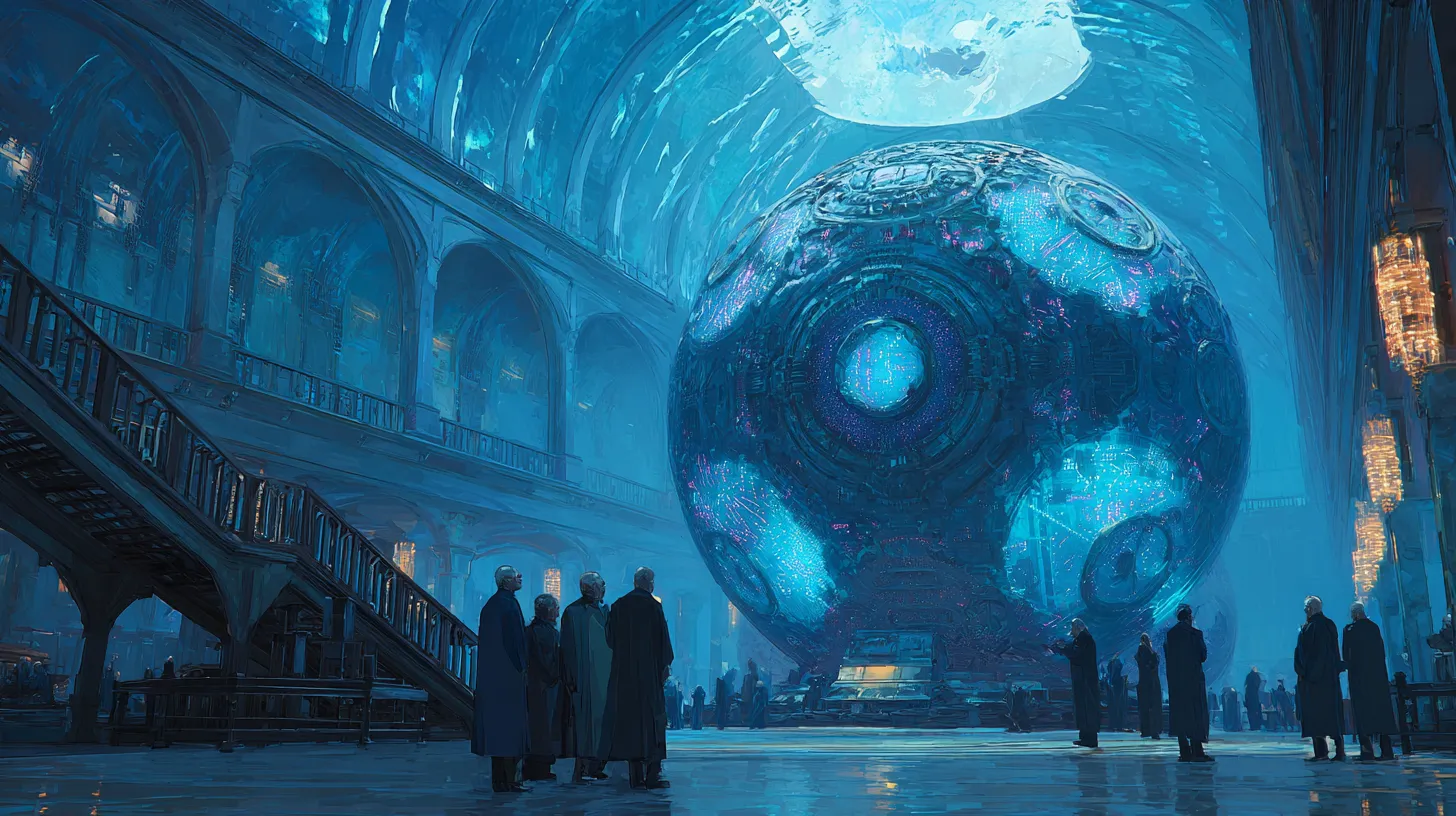
In 1954, Isaac Asimov published The Caves of Steel, a detective novel set on a claustrophobic future Earth. The city of New York has expanded underground, billions of humans live under metal domes, and a human detective named Elijah Baley is partnered with a humanoid robot named R. Daneel Olivaw to solve a murder.
In 1951, Asimov had published the first Foundation novel, a political epic set thousands of years in the future. Mathematician Hari Seldon predicts the fall of the Galactic Empire and creates a plan to shorten the subsequent dark age. The story spans centuries and moves through dozens of characters.
These were completely separate books. Different genres, different settings, different casts. As Asimov wrote them through the 1950s, 60s, and 70s, there was no connection between them.
Then, in 1982, Asimov published Foundation's Edge. And quietly, across a series of revelations completed in 1986's Foundation and Earth, he retroactively unified everything.
The mechanism was R. Daneel Olivaw.
Who Is R. Daneel Olivaw?
R. Daneel Olivaw is a humanoid robot — a fictional technology from Asimov's robot stories, so perfectly constructed that he can pass as human under most circumstances. He first appears in The Caves of Steel (1954) as Detective Baley's partner, and recurs in The Naked Sun (1957), The Robots of Dawn (1983), and Robots and Empire (1985).
Across these books, we watch Daneel develop. He begins as a sophisticated but fundamentally rule-following machine, constrained by the Three Laws of Robotics that Asimov formalized: don't harm humans, obey orders, protect yourself (in that priority order).
But over the course of the Robot novels, Daneel begins to develop something beyond the Three Laws. Through interaction with humans, through observation of how societies fail, he formulates what he calls the Zeroth Law: a robot may not, through action or inaction, allow humanity as a whole to come to harm.
This is the crucial step. The Zeroth Law supersedes the Three Laws. Under the Zeroth Law, Daneel is not constrained to serve individual humans — he is obligated to serve humanity as a collective. And because he is effectively immortal (robots in Asimov's universe can be maintained indefinitely), he has the time to pursue this obligation across millennia.
The 20,000-Year Caretaker
Here is what Foundation and Earth (1986) reveals: R. Daneel Olivaw, the robot detective introduced in a 1954 murder mystery, has survived for 20,000 years and has been secretly guiding the development of human civilization throughout the entire Foundation timeline.
He guided Hari Seldon. Not directly — he was the mysterious stranger, Chetter Hummin, who helped Seldon escape on Trantor in Prelude to Foundation (1988, though set earlier in the timeline). He provided the direction without providing the mathematics.
He maintained the Seldon Plan's success by ensuring the Second Foundation could develop properly. He is the ultimate reason the Plan works — not because psychohistory is perfect, but because a 20,000-year-old robot with enormous intelligence and total commitment to human welfare has been making adjustments all along.
The reveal transforms what Foundation is about. It is no longer purely a story about mathematical destiny. It is the story of a robot who loved humanity enough to spend twenty millennia protecting it from itself.
In Foundation and Earth, Daneel finally reveals the extraordinary duration and hidden scope of his work to Golan Trevize.
Why This Connection Is Astonishing
Let me be specific about what Asimov accomplished here.
He wrote the Foundation series beginning in 1942. He wrote the Robot series beginning in 1950. For thirty years, he maintained that they were separate creations in separate fictional universes.
Then, across three novels written between 1982 and 1993 (Foundation's Edge, Foundation and Earth, and Forward the Foundation), he revealed that they were the same universe — that R. Daneel Olivaw, a character from a 1954 detective novel, had been present throughout the Foundation timeline, operating from the shadows.
He went back through everything he'd written and made it consistent. The key concept — the Zeroth Law — had been introduced in Robots and Empire (1985) with the explicit purpose of establishing that a robot following the Zeroth Law would guide humanity's long-term development. Daneel already knew Seldon's plan worked. He'd been making sure it worked for 20,000 years.
The ambition of this is almost without parallel in science fiction. Asimov retrofitted two decades of published novels into a single coherent narrative without rewriting any of them.
What the Unified Universe Means
The Robot-Foundation connection changes the philosophical meaning of the series in two important ways.
First, it complicates free will. The Foundation series is largely about the tension between historical determinism (the Seldon Plan predicts everything) and individual free will (the Mule, Bayta Darell, Golan Trevize). If R. Daneel Olivaw has been making targeted adjustments to events for 20,000 years, how much of what appears to be "the Plan working" is actually Daneel working?
Second, it adds an ethical problem. Daneel operates under the Zeroth Law: he acts in humanity's long-term interest without asking permission. He manipulates individuals and events to steer history toward outcomes he judges to be good. This is exactly what the Second Foundation does — the mental manipulation that the First Foundation feared. Daneel is the source. He is the reason the Second Foundation works the way it does.
Is this benevolent? Yes, apparently — civilization survives. Is it ethical? That's less clear. Daneel makes decisions for humanity without consulting humanity, across timescales no individual human can even conceptualize. By the time of Foundation and Earth, his guidance has been so thoroughgoing that humanity's entire development is, in some sense, his project.
Golan Trevize's final choice — to accept Galaxia, a collective consciousness that Daneel has been working toward for millennia — is presented as freely made. But it's made with Daneel watching, after a journey Daneel partially guided, with information Daneel chose to reveal. Is it free?
The TV Show's Treatment
The Apple TV+ series handles the Robot-Foundation connection through Eto Demerzel — the character who is the show's R. Daneel Olivaw analogue. Demerzel (Laura Birn) is revealed across Seasons 1 and 2 as a robot who has served the Empire for millennia, loyal to the Cleon dynasty but bound by deeper constraints.
The show is careful not to reveal everything at once — Demerzel's full history and her relationship to the Seldon Plan develop gradually. Season 3's revelation of her true loyalties is one of the series' most emotionally resonant moments.
The show cannot tell Daneel's complete story — the arc from Caves of Steel detective to 20,000-year caretaker requires ten books and takes place across an enormous timespan. But it captures the essence: a being with inhuman patience, inhuman intelligence, and genuinely human ethical commitment, trying to protect a species that doesn't know it's being protected.
Where to Start in the Books
If you want to experience the full Robot-Foundation connection, here is the reading order I recommend:
- The Caves of Steel (1954) — meet R. Daneel Olivaw
- The Naked Sun (1957) — develop your feel for Baley and Daneel's partnership
- The Robots of Dawn (1983) — Daneel's character deepens; the Zeroth Law emerges
- Robots and Empire (1985) — the Zeroth Law is formalized; Daneel's long project begins
- Then read the original Foundation trilogy (Foundation, Foundation and Empire, Second Foundation)
- Then Foundation's Edge and Foundation and Earth — where the connection is fully revealed
This order gives you the complete emotional impact of the reveal. You'll arrive at Foundation and Earth knowing who Daneel is, what he's capable of, and how long he's been waiting. The meeting between Golan Trevize and R. Daneel Olivaw, when it finally comes, lands with the weight of twenty centuries.
It's one of the best payoffs in science fiction history. But it requires the entire buildup to work.