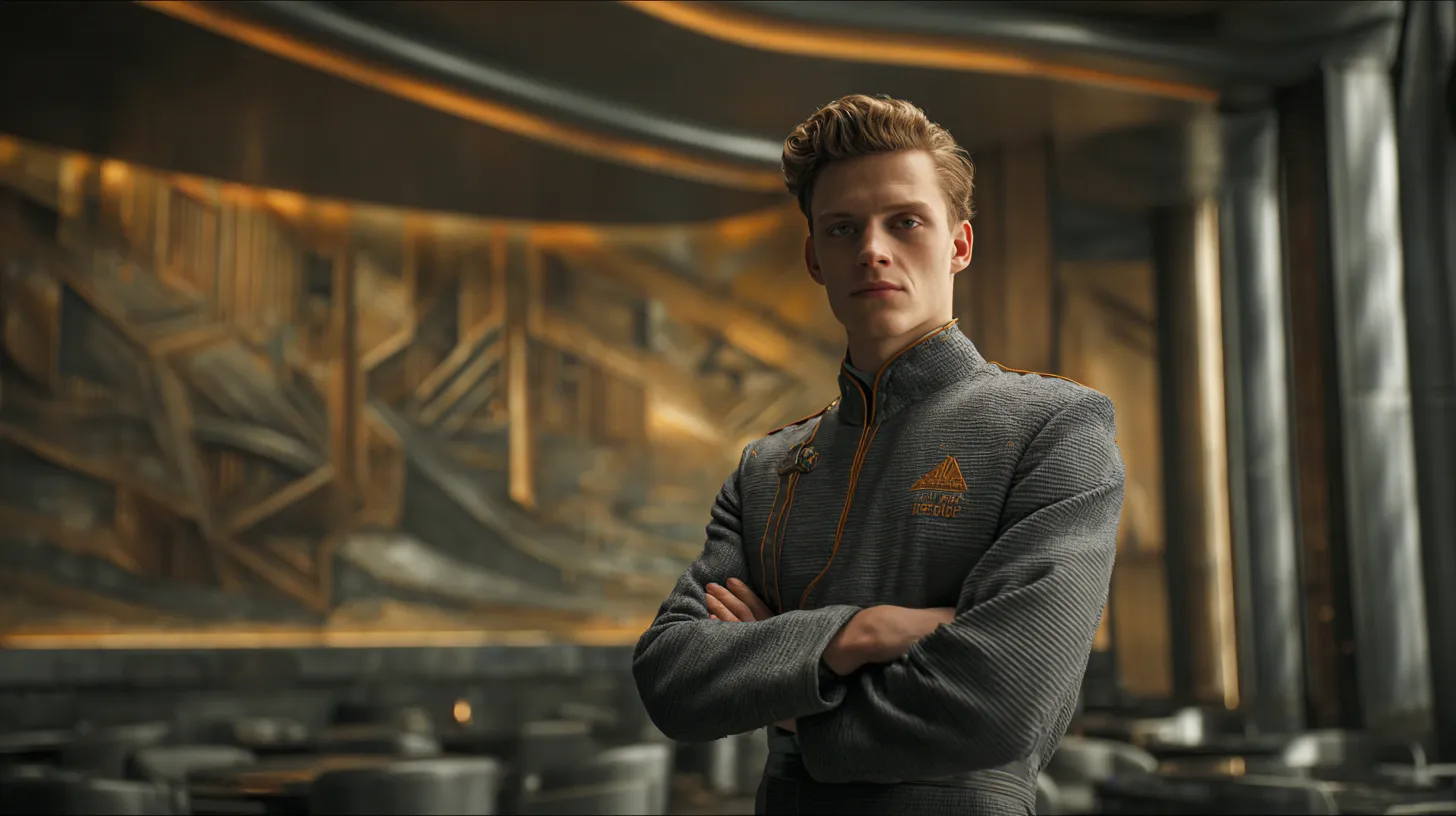
Salvor Hardin
First Mayor of Terminus who established the Foundation's political power through religion.
Quick Summary
Salvor Hardin is the first Mayor of Terminus in Asimov's Foundation. He resolved the first two Seldon Crises by replacing the Board of Trustees and establishing a religion of science to control neighboring kingdoms through technological dependence.
Last updated: 2026-09-23
Appears In
- Foundation
Key Traits
- Politician
- Mayor
- Diplomat
- Strategist
Importance
Master of Politics in the Foundation saga
"Violence is the last refuge of the incompetent."
This line, Salvor Hardin's most famous, spoken early in Foundation (1951), is one of the most quoted lines in science fiction. It's often cited as a simple observation about the limits of force. But in context, it's actually a description of Hardin's entire strategic philosophy: the belief that a sufficiently clever political operator never needs to resort to violence, because violence is what you do when you've run out of smarter options.
Hardin runs out of smarter options exactly never. He defeats two existential military threats to the Foundation using nothing but leverage, timing, and a careful understanding of human psychology. He does this while surrounded by academics who think the Encyclopedia is the point, by an Empire that is too large and too decayed to notice him, and by Anacreon warlords who think military power is everything.
He is the Foundation's first great mind. Not its greatest; that's Hari Seldon, who built the system Hardin inhabits. But Seldon built a machine that predicts history at the level of civilizations. Hardin operates at the level of individuals, and he is just as impressive.
Background: The Mayor of Terminus
Salvor Hardin is the first Mayor of Terminus, the remote planet at the edge of the galaxy where the Foundation was exiled. When we first meet him in Foundation, he's a young politician trying to navigate the chaos of an Encyclopedia project that, he correctly suspects, is not what it appears to be.
The Encyclopedia Foundation was Hari Seldon's cover story. The real purpose of the exile was to create a nucleus of civilization that would survive the coming dark age. Hardin is one of the first people to figure this out, by actually paying attention to what's happening around him, rather than what the Board of Trustees tells him is happening.
He seizes political control of the Foundation through what amounts to a quiet coup during the First Seldon Crisis: the moment when the First Foundation's existence is genuinely threatened. He doesn't need a shot fired: with his ally Yohan Lee, he simply takes power while the Board of Trustees is still waiting for Seldon to rescue them.
The First Seldon Crisis: Anacreon
The First Seldon Crisis is triggered when Anacreon, the most powerful of the Four Kingdoms that formed near Terminus after the Empire's withdrawal, moves to annex Terminus.
The Board of Trustees wants to negotiate. The Empire wants to ignore the problem. Hardin sees something that neither of them sees: the Foundation has a weapon that Anacreon desperately needs. Not the Encyclopedia. Not military technology. Nuclear power.
After the Empire's withdrawal, the surrounding kingdoms have lost the ability to maintain advanced technology. Anacreon has fallen back on coal and oil; it has lost nuclear power altogether. Terminus still has it, and that is exactly why Anacreon wants the planet.
Hardin's solution is to make this dependency explicit, while simultaneously playing the Four Kingdoms against each other. He visits the other three kingdoms and convinces them that none of them can allow Anacreon alone to seize nuclear power. Their joint ultimatum forces Anacreon to back down, and the Foundation becomes the region's indispensable source of technology.
He never fires a weapon. He defeats a military threat by making war too expensive to wage.
The Second Seldon Crisis: The Wienis Rebellion
The Second Crisis is trickier, because Hardin's earlier victory has created a new problem: he used the Foundation's monopoly on nuclear technology to establish a religion around that technology, with Foundation-trained priests maintaining equipment that their users experience as miraculous. This worked brilliantly for thirty years. Then Anacreon's Prince Regent Wienis decided to turn a salvaged Imperial battle cruiser, restored by Foundation engineers, against the Foundation itself, timed for his nephew King Lepold's coronation while Hardin was his guest.
Hardin had set two traps. The engineers who restored the cruiser left the Foundation a hidden control over it, and the priests who ran Anacreon's technology answered to Terminus. When Wienis launched the attack, the ship's crew mutinied, and every Foundation-maintained power plant on Anacreon went dark under a religious interdict.
Hardin had thought decades ahead. He didn't just use the Foundation's technical advantage as leverage; he converted that advantage into a belief system that would make the Foundation's destruction literally unthinkable to anyone trained within it.
"It's a poor atom blaster that won't point both ways." — Salvor Hardin, Foundation (1951)
Wienis, with his people in revolt, tries to shoot Hardin, fails against Hardin's personal force field, and turns the weapon on himself. Terminus is never attacked. The Seldon Plan advances.
What Made Hardin Different
Hardin's genius was in refusing to accept the constraints other people accepted as given.
The Board of Trustees accepted that the Foundation was an encyclopedia project. Hardin looked at the situation and asked: what do we actually have that anyone wants? Answer: technical knowledge. How do we protect ourselves using that? Answer: make everyone dependent on us before anyone can threaten us.
The Empire accepted that the Foundation was peripheral. Hardin asked: how peripheral is so peripheral that the Empire will never bother to pay attention? Answer: sufficiently remote that local disputes resolve themselves before the Empire notices.
This is practical intelligence of a very high order. It's the kind of thinking that doesn't get credit in academic philosophy or political theory, because it's too situational, too tactical, too much about reading specific people in specific situations. But it's the kind of thinking that actually works.
Salvor Hardin in the Apple TV+ Series
The TV series' Salvor Hardin (Leah Harvey) is a significant reinvention of the original character. Book-Hardin is a male politician, probably middle-aged by the time of the crises, who operates through language and negotiation. TV-Hardin is a young woman who serves as Warden of Terminus, a physically active, combat-capable role.
The show maintains the essential quality of Hardin's character, the ability to think around problems rather than through them, while completely changing the circumstances. TV-Hardin's connection to the Vault and her psychic sensitivity to the Seldon Plan are original inventions that have no counterpart in Asimov's novels.
The choice to gender-swap Hardin was one of the show's most successful adaptations. Leah Harvey brings an intensity to the role that makes the TV Hardin feel like a genuine hero rather than a convenient political device. The character loses Asimov's dry wit and gains physical courage and emotional directness.
These are different characters with the same name, and both work on their own terms.
Hardin's Place in Foundation History
Salvor Hardin leads the Foundation through its first two Seldon Crises, about thirty years apart (around 50 and 80 F.E.), and then disappears from the active narrative as the story jumps forward. He's mentioned occasionally in later sections as a historical figure.
He leaves behind a Foundation that is politically independent and dominant in its region, and a habit of mind: use technical and political leverage instead of military force. That habit shapes the Foundation's culture for generations.
The later Merchant Princes who follow him (Hober Mallow is the most prominent) inherit his approach: identify the dependency, cultivate it, turn it into power. They add the commercial dimension that Hardin never fully exploited. But the foundation of the approach is Hardin's.
He is not a warm character: he's calculating, sometimes ruthless about ends and flexible about means. But he's honest about what he's doing and why. He never mistakes his methods for principles. He knows the Foundation needs to survive before it can be good, and he's willing to be hard so that the institution can eventually be generous.
Facing two genuinely existential threats, he is never once wrong about the situation. That is, in Asimov's universe, the clearest possible proof of a great mind.
Related Characters & Key Relationships
Continue from Salvor Hardin into the allies, rivals, and successors who shape the same arc.
Continue Exploring
More Paths From Salvor Hardin
Move from the character profile into the concepts and articles that explain their role in the wider Foundation universe.
Related Concepts
Location
Anacreon
Anacreon is the most powerful of the Four Kingdoms that emerged near Terminus after the Galactic Empire's withdrawal from the Periphery. Its military threats forced the Foundation through its first Seldon Crisis, establishing the pattern of existential challenges that would define the Foundation's first centuries.
ContinueProject
Encyclopedia Galactica
The Encyclopedia Galactica is a comprehensive compendium of all human knowledge, originally presented as the primary purpose of the First Foundation on Terminus. In reality, it served as a cover for the true mission of the Seldon Plan.
ContinueEvent
Seldon Crisis
A Seldon Crisis is a pivotal historical moment predicted by psychohistory where the Foundation faces an existential threat with only one viable solution. These crises serve as checkpoints in the Seldon Plan, ensuring civilization stays on the path toward a Second Galactic Empire.
ContinueRelated Reading
Locations
Terminus: The Foundation at the Edge of the Galaxy
From a lonely outpost to the seed of a new Empire. Discover the history of Terminus, the home of the First Foundation.
ContinueTV Series
Foundation Books vs Show: Every Difference Through Season 3
A comparison of Isaac Asimov's Foundation novels and the Apple TV+ adaptation, from the cloned emperors and gender-swapped characters to the Vault, the Mule, and what the show has yet to reach.
ContinueConcepts
What Is the Prime Radiant? Seldon's Mathematical Blueprint for Saving Civilization
The Prime Radiant stores and displays the equations of the Seldon Plan. Here's what the books actually say about it, how the Second Foundation uses it, and how the Apple TV+ series reinvents it.
ContinueFrequently Asked Questions About Salvor Hardin
What is Salvor Hardin's most famous quote?
Salvor Hardin's most quoted line is 'Violence is the last refuge of the incompetent,' which he uses to argue against military action in favor of political and intellectual solutions. Another well-known quote is 'Never let your sense of morals prevent you from doing what is right.'
How did Salvor Hardin save the Foundation?
Hardin saved the Foundation during the first Seldon Crisis by recognizing that the Board of Trustees' academic approach was inadequate against the military threat from Anacreon. He staged a bloodless coup, took political control, and established a 'religion of science' that made neighboring kingdoms technologically dependent on the Foundation.