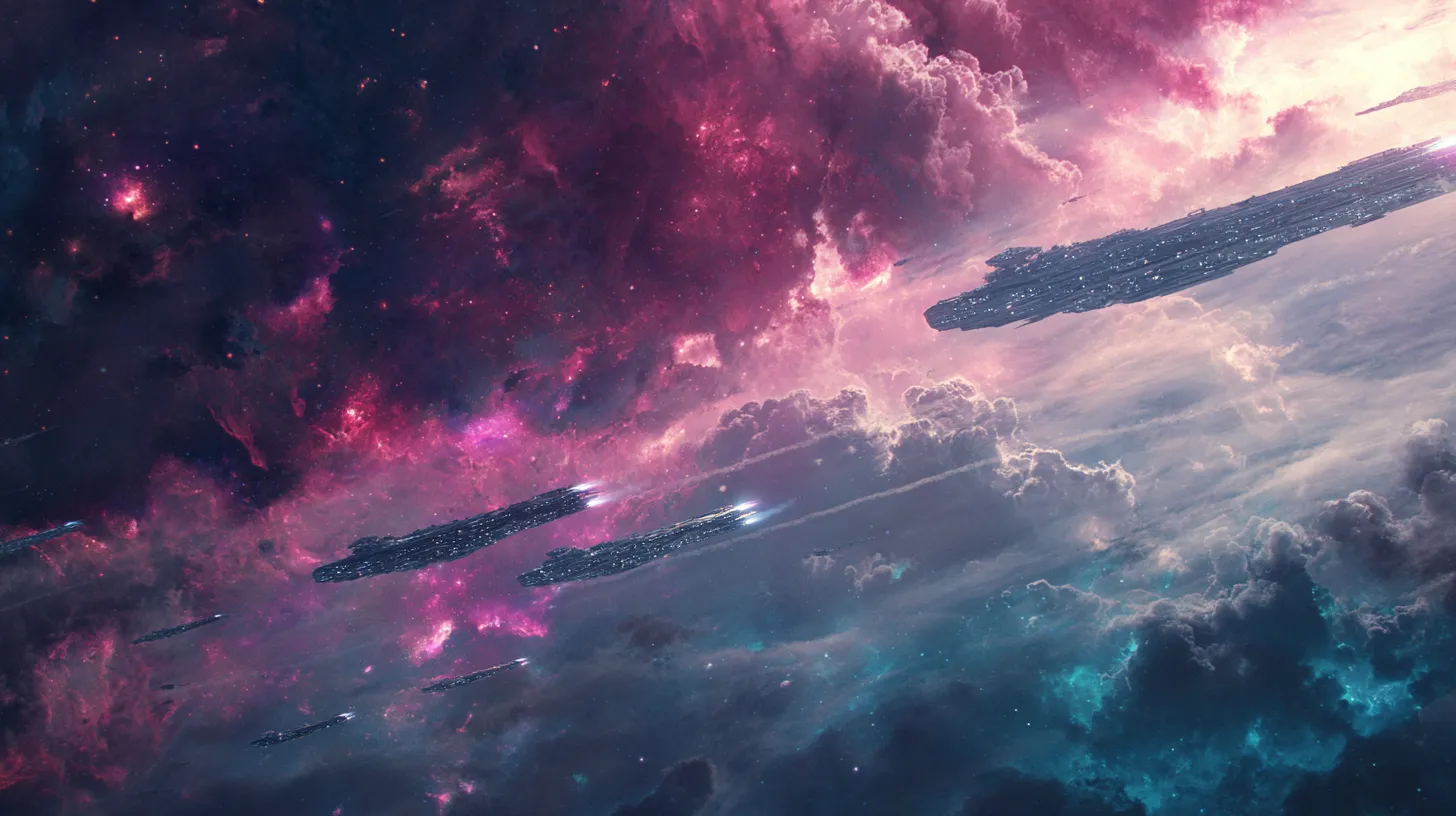
Starships equipped with hyperatomic jump drives capable of folding space—from Asimov's classic hyper-jumps to Apple TV+'s Spacer-operated Imperial rings and the Foundation's revolutionary whisper-ships.
Jump ships are faster-than-light spacecraft in Foundation that cross interstellar distances almost instantaneously by folding space through hyperspace. In Isaac Asimov's novels, all mature galactic civilizations use standard hyperatomic jumps with complex 3D vector math; in Apple TV+'s series, the Empire monopolizes giant ring-drive jump ships crewed by enslaved Spacers until the Foundation reverse-engineers the Invictus to build Spacer-free whisper-ships.
Creator
Galactic Empire & Foundation Engineers
Type
Interstellar Propulsion
Purpose
Faster-Than-Light Transit
Practitioners
Spacers, Imperial Fleet, Foundation Traders
Core Principles
Folding Space Through Hyperspace
Instead of accelerating past light speed in normal space, a jump ship calculates complex gravitational trajectories and drops momentarily through hyperspace—emerging light-years away in an instant.
The Spacer Monopoly (Apple TV+)
In the Apple TV+ series, Imperial jump ships depend on giant spinning rings and genetically engineered, biochemically enslaved Spacers to endure the trauma of jump calculation.
Whisper-Ship Revolution
After salvaging the ancient warship Invictus in Season 1, Terminus pioneers compact whisper-ships that fold space without massive exterior rings or enslaved Spacer crews—shattering Imperial transit supremacy.
Book Canon vs. Apple TV+ Jump Technology
In Isaac Asimov's novels, faster-than-light 'hyper-jumping' is routine across the Empire and Foundation alike, relying on positronic/hyperatomic computers and careful micro-jumps clear of planetary gravity wells. Asimov later traced early FTL experiments back to Earth's Spacer and Settler worlds.
The Apple TV+ adaptation turns jump travel into one of its sharpest political weapons. By restricting Imperial jump ships to colossal ring-hulled cruisers operated by enslaved Spacers, Empire controls commerce and military response across the galaxy—until the First Foundation unlocks the Invictus's secret.
In Depth
How Faster-Than-Light Travel Shapes the Foundation Universe
No galactic empire—or galactic civilization trying to preserve knowledge across thirty thousand parsecs—can exist without faster-than-light travel. Across both Isaac Asimov's novels and Apple TV+'s television adaptation, jump ships determine who controls trade, warfare, and information. Yet the two versions treat jump technology in noticeably different ways.
In the books, hyperatomic jumps are mature engineering shared across the galaxy; the Empire fails from political inertia rather than losing access to FTL drives. In Apple TV+'s Foundation, however, the mechanics of jump ships, enslaved Spacers, and Foundation whisper-ships lie right at the center of the cold war between Trantor and Terminus.
Jump Travel in Isaac Asimov's Novels
In Asimov's original stories—starting with Foundation (1951) and expanding across the Robot and Empire novels—starships cross interstellar voids using a hyperatomic motor (often simply called the Jump). Rather than moving faster than light through normal Einsteinian space, a vessel drops briefly through hyperspace and reappears light-years away, essentially trading distance for complex three-dimensional gravitational mathematics.
Key features of Asimov's book canon include:
Mass & Gravity Constraints: Jumps become dangerous near dense stellar gravity wells, so ships calculate precise "micro-jumps" out to clear space or leap carefully between calculated coordinate points.
Routine Logistics: By the peak of the Galactic Empire, Imperial warships, Merchant Princes' traders like Hober Mallow, and civilian liners all possess jump drives. Technological decline appears later as the Periphery kingdoms lose atomic maintenance skills—not because one caste holds a genetic monopoly on navigation.
Long-Term Evolution (Sequels): By Foundation's Edge (1982) and Foundation and Earth (1986), the First Foundation builds advanced gravitic ships (Far Star) using non-inertial gravitational repulsion alongside fast, silent hyperspace computers—culminating in ships that appear effortless compared with older Imperial hulks.
Imperial Jump Ships & Spacers on Apple TV+
David S. Goyer's Apple TV+ series radically dramatizes FTL navigation to illustrate how brittle the Cleon Genetic Dynasty really is.
In the show, Imperial jump ships—from colossal Home Swarm troop carriers to Brother Day's flagship Shining Destiny—rely on enormous exterior spinning jump rings surrounding the main hull. Even more critically, human pilots and conventional computers cannot withstand the neural overload of folding space.
The Enforced Monopoly of the Spacers
To bridge the gap, the Galactic Empire exploits Spacers—a genetically engineered, cybernetically modified post-human group originally descended from early interstellar navigators (borrowing the name, though not the pampered robot-estate lifestyle, of the Spacers in Asimov's Robot novels such as Aurora and Solaria).
Kept compliant through tight rationing of opalecks (a vital genetic/biochemical nutrient only the Empire controls), Spacers spend long stretches locked inside suspension pods, woken only to absorb the crushing sensory pain of calculating and folding a ship across hyperspace.
Because the Galactic Empire enforces strict monopolies on both ring-drive shipyards and Spacer populations, distant planets like Terminus or Anacreon cannot easily build rival deep-space navies—until Season 1's discovery of The Invictus.
The Whisper-Ship Breakthrough (Seasons 1–3)
Everything shifts when Salvor Hardin captures the lost pre-Cleonic dreadnought Invictus in Season 1 and jumps it to Terminus. Unlike later Imperial ships, the Invictus predated the Spacer monopoly or preserved autonomous jump architectures that did not require enslaved human navigators.
During the 138-year gap between Season 1 and Season 2, Terminus engineers reverse-engineer those schematics to produce whisper-ships—such as Brother Constant's missionary vessel Spirit Rising and trader Hober Mallow's craft:
No Exterior Jump Rings: Whisper-ships hide compact singularity/fold drives internally, giving them sleek, agile silhouettes that appear harmless alongside Imperial juggernauts.
No Spacers Required: Biological/synthetic neural arrays replace human Spacer navigators entirely.
Rapid Strike & Stealth: Whisper-ships can jump virtually anywhere on demand without filing fleet-guild flight telemetry—allowing Foundation "missionaries" and traders to outmaneuver the Empire across the Outer Reach.
In Season 2 Episode 9 ("Long Ago, Not Far Away"), Hober Mallow delivers a decisive blow to Imperial transit supremacy by sneaking a whisper-ship into the Spacer mothership Home Swarm and offering them the genetic freedom to synthesize opalecks without Trantor. In the climactic space battle above Terminus, the Spacers turn the Shining Destiny's own fleet jump coordinates against one another—wiping out Brother Day's armada alongside General Bel Riose.
Why Jump Technology Matters to Psychohistory
In Asimov's philosophy of history, technology is never just window dressing—it redistributes power. Just as Foundation tracks Terminus's transition from nuclear monopoly (Hardin) to merchant trade (Mallow) to gravitic drives (Trevize), Apple TV+'s transition from Spacer-enslaving ring ships to autonomous whisper-ships turns spacecraft engineering into the clearest visual proof that the Galactic Empire is no longer the center of innovation.
Related Guides
The Invictus — the 700-year ghost warship behind Foundation whisper-ships
Anacreon — how outer kingdoms first fought over imperial fleet power
Jump ships achieve faster-than-light travel by calculating gravitational vectors and folding space through a higher-dimensional jump, crossing hundreds or thousands of light-years almost instantaneously.
What is the difference between Imperial Jump Ships and Foundation Whisper-Ships?
In the Apple TV+ series, Imperial jump ships rely on colossal spinning rings and genetically modified human Spacers kept captive by opalecks. Foundation whisper-ships, reverse-engineered from the Invictus, are far smaller, stealthier, and navigate jumps without Spacers.
Did Isaac Asimov invent Whisper-Ships or Spacer navigators?
No. In Asimov's novels, Spacers are the long-lived robot-dependent humans of the Outer Worlds (Aurora, Solaria) rather than mutant jump-ship navigators, and 'whisper-ships' are an original Apple TV+ invention inspired by Hober Mallow's superior Foundation technology.