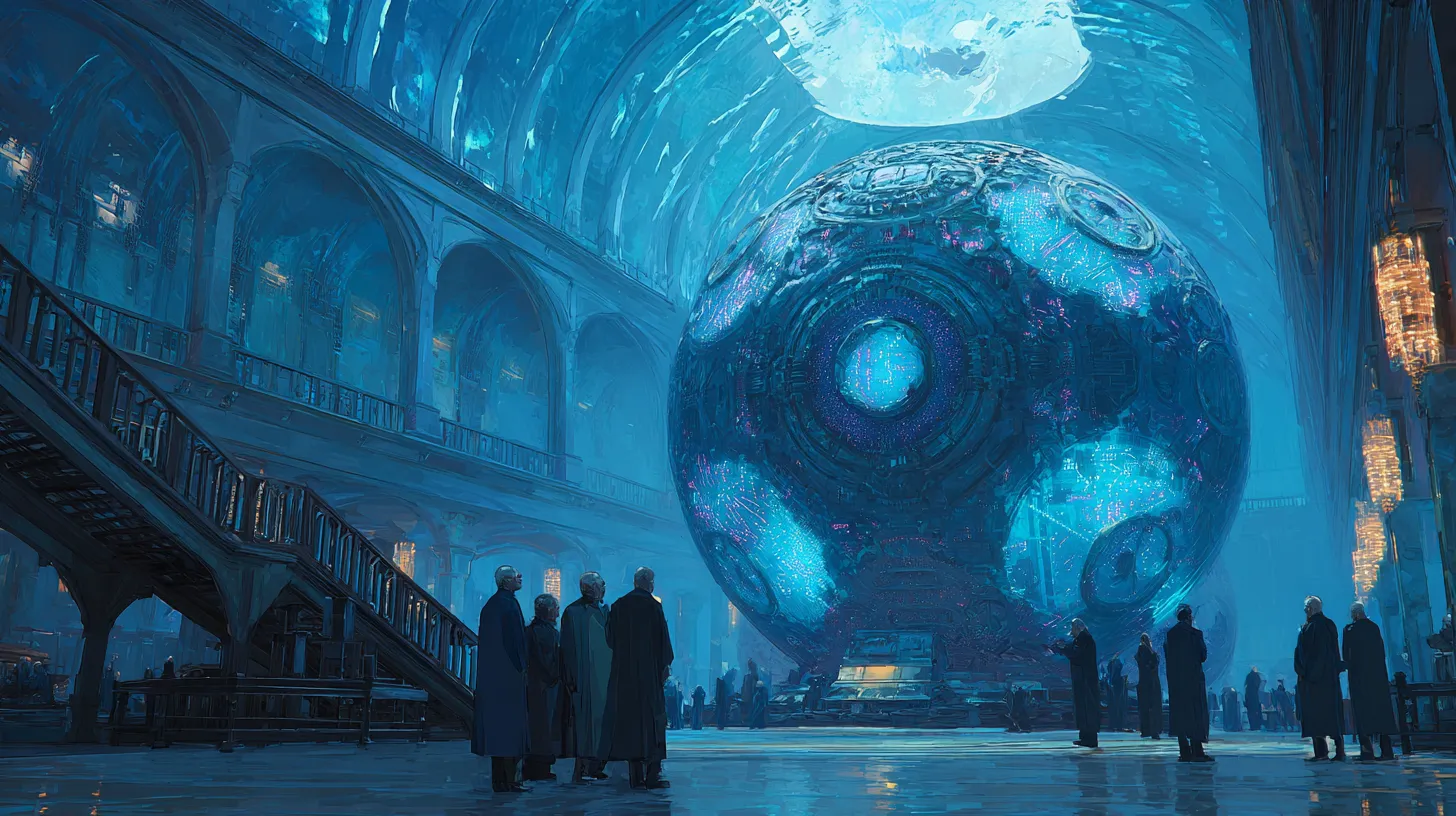
Is the future written in stone, or is it a chaotic river of chance? In the Foundation universe, Hari Seldon proved it was neither. It was a statistical probability. This is the essence of Psychohistory.
What is Psychohistory?
Psychohistory is a fictional science combining history, sociology, and statistical mathematics. Its core premise is simple yet profound: while you cannot predict the actions of a single individual, you can predict the flow of vast populations, the quadrillions of people who make up the Galactic Empire.
The Gas Analogy
Seldon often compared humanity to a gas. You cannot predict the motion of a single gas molecule, but using the Kinetic Theory of Gases, you can predict the pressure, temperature, and volume of the gas as a whole with extreme precision.
The Prime Radiant
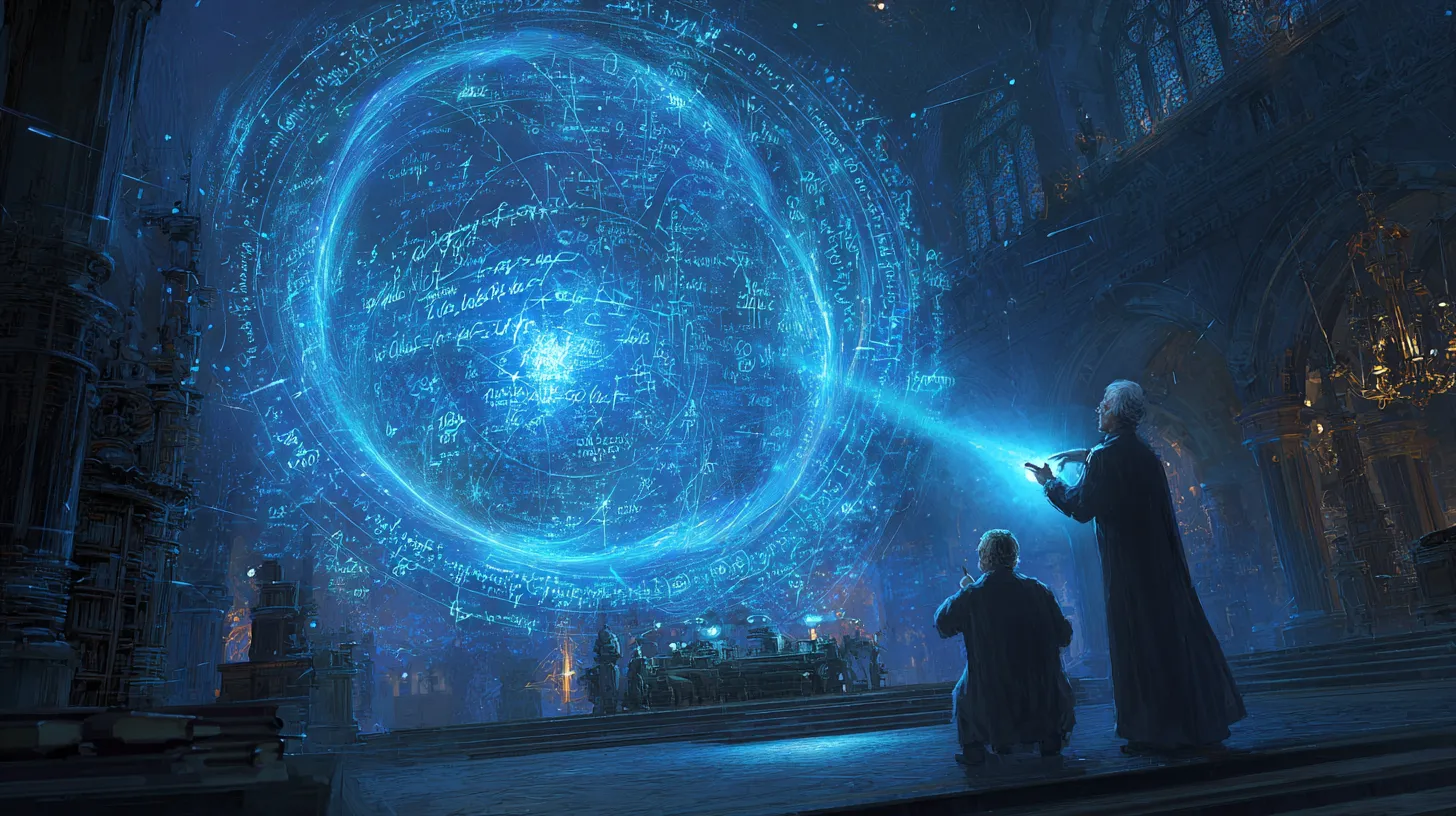
To visualize and manipulate the incredibly complex equations of Psychohistory, Seldon developed the Prime Radiant. This device could project the entire Seldon Plan onto a wall or air as a complex web of glowing lines and equations.
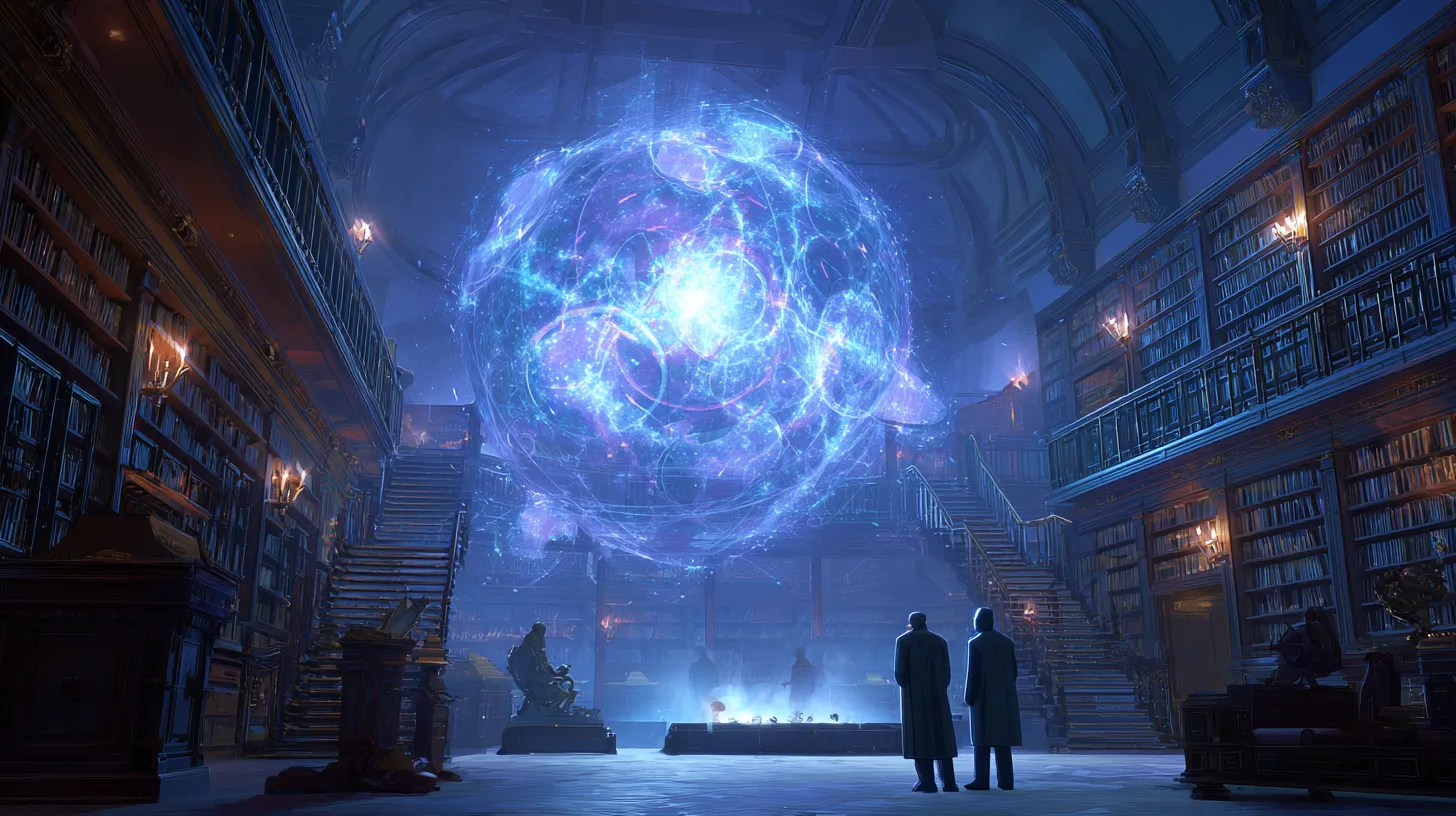
The Prime Radiant was not just a projector; it was a dynamic tool. The Second Foundationers used it to constantly adjust the Plan, accounting for small deviations to ensure the ultimate goal remained on track.
The Seldon Plan
Seldon's math revealed a terrifying truth: the Galactic Empire was falling, and a dark age of 30,000 years was inevitable. Psychohistory could not stop the fall, but it could limit the suffering.
The Goal
The aim of the Seldon Plan was to reduce the interregnum, the period of chaos between the First and Second Empires, from 30,000 years to a mere 1,000 years.
To achieve this, Seldon established two Foundations:
- The First Foundation on Terminus, focused on physical sciences and political power.
- The Second Foundation at "Star's End" (Trantor), focused on mentalics and the stewardship of the Plan itself.
Limits of the Science
Psychohistory had two fundamental axioms (assumptions) required for it to work:
- The population must be sufficiently large, numbering in the billions and beyond.
- The population must remain unaware of the results of the psychohistorical analysis.
If the public knew the predictions, their reactions would change the outcome, a kind of observer effect. This is why the true nature of the Seldon Plan was kept a closely guarded secret, revealed only in cryptic holographic messages from Seldon himself during major crises.
Moreover, the science failed to account for the "Mule," a mutant individual with powerful mental abilities. Since he was a singular anomaly rather than a statistical trend, he disrupted the Plan entirely, proving that even the most perfect math cannot account for the truly unpredictable.
Real-World Parallels
While psychohistory is fictional, its core idea, that the behavior of large populations can be predicted mathematically even when individual behavior cannot, has inspired real academic disciplines:
-
Cliodynamics: Founded by Peter Turchin at the University of Connecticut, this field uses mathematical models to study historical dynamics. Turchin has discussed Asimov's psychohistory as a point of comparison, and his work on "secular cycles" of political instability has gained attention for accurately modeling patterns of social unrest.
-
Econophysics: The field of econophysics applies statistical mechanics (the same "gas analogy" Seldon used) to economic systems. Researchers model markets as systems of interacting particles, finding that aggregate behavior follows predictable patterns even though individual trading decisions appear random.
-
Big Data and Predictive Analytics: Modern data science fulfills aspects of psychohistory's vision. Large technology companies use massive datasets to predict population-level behavior, from consumer trends to what people will click next. The ethical implications mirror Seldon's dilemma: should the population know it is being predicted?
The economist Paul Krugman, a Nobel laureate, has written that Foundation made him want to be a psychohistorian, and that economics was the closest real discipline he could find.
Psychohistory in the Apple TV+ Adaptation
The Apple TV+ series (2021–2025) visualizes psychohistory as flowing mathematical equations that Hari Seldon (played by Jared Harris) manipulates in the air using the Prime Radiant. The show adds a mentalic dimension absent from the books, suggesting that psychohistory may be connected to psychic abilities, particularly through the character of Gaal Dornick (Lou Llobell).
In Season 3, psychohistory is tested to its limits by the Mule (Pilou Asbæk), whose emotional conversion abilities render Seldon's predictions useless. The show faithfully adapts this as the central crisis of the Mule arc: the one variable that psychohistory cannot account for is a unique individual who can single-handedly alter galactic history.
The Ethical Dilemma
Psychohistory raises profound ethical questions that Asimov explored throughout the series. Is it morally acceptable to manipulate entire civilizations for their "own good"? The Second Foundation, which secretly adjusts the Plan from the shadows, practices a kind of benevolent dictatorship, shaping history without the consent of those being shaped.
This tension between determinism and free will becomes the saga's central philosophical conflict. The character of Golan Trevize in Foundation's Edge ultimately chooses a path that transcends both the First Foundation's technological determinism and the Second Foundation's mental control — opting instead for Galaxia, a collective consciousness that would make psychohistory unnecessary by uniting all of humanity into a single organism.
Common Misconceptions About Psychohistory
"Psychohistory predicts what individuals will do." It does not, and Seldon says so himself. From its first appearance in "The Psychohistorians," the opening story of Foundation (1951), the science is defined as working only on populations too large for any single person to matter. The moment an extraordinary individual like the Mule appears, the equations fail.
"Seldon planned every event in detail." The Plan charts broad currents, not scripts. Each Seldon Crisis is a designed moment of pressure in which the Foundation is left with exactly one viable path forward, but the specific people, dates, and battles are never predetermined. When Seldon's recording appears in the Time Vault, it speaks in probabilities, and in Foundation and Empire it famously describes a crisis that is not the one unfolding, proving how far the Mule had knocked history off course.
"The Plan survived the Mule intact." It did not. The Mule's conquest in Foundation and Empire (1952) shattered the Plan completely, and the Second Foundation had to intervene directly, manipulating minds, sacrificing some of its own agents, and revealing its existence, before its analysts could calculate, by the end of Second Foundation (1953), that the Plan was back on course.
"Psychohistory is prophecy dressed up as math." Prophecy claims certainty; psychohistory claims only probability about masses, and it breaks the instant its axioms are violated. Asimov, a trained biochemist, modeled it on the kinetic theory of gases, which is exactly why the gas-molecule analogy appears so often in the books.
Where Psychohistory Appears in the Books and Show
In print, psychohistory anchors every Foundation novel. Seldon presents it at his trial before the Commission of Public Safety in Foundation (1951); it drives the Mule duology in Foundation and Empire (1952) and Second Foundation (1953); and it is questioned directly in Foundation's Edge (1982) and Foundation and Earth (1986), where Golan Trevize asks whether a plan made by one man, even Seldon, deserves to govern a galaxy. The two prequels, Prelude to Foundation (1988) and Forward the Foundation (1993), show the science being invented: a young Seldon fleeing across Trantor with little more than a half-formed idea, and an older Seldon completing the equations at terrible personal cost.
On screen, the Apple TV+ series turns psychohistory into a visual language, glowing equations Seldon sculpts in the air, and, unlike the books, ties it to Gaal Dornick's mentalic abilities. Season 3 stages the science's ultimate stress test, as the Mule's emotional conversion renders generations of prediction useless.
Frequently Asked Questions
What is psychohistory in the Foundation series?
Psychohistory is a fictional science developed by mathematician Hari Seldon that combines history, sociology, and statistical mathematics to predict the behavior of large human populations. While it cannot predict individual actions, it can forecast the general course of civilizations spanning quadrillions of people. Seldon used it to predict the fall of the Galactic Empire and design a plan to shorten the resulting dark age from 30,000 years to 1,000.
Is psychohistory a real science?
Psychohistory as described in Foundation is fictional, but it has inspired real academic fields. Cliodynamics, founded by Peter Turchin, applies mathematical modeling to historical dynamics. Econophysics uses statistical mechanics to model economic systems. Modern predictive analytics and big data science also fulfill aspects of psychohistory's vision, using massive datasets to forecast population-level behavior.
What is the Prime Radiant?
The Prime Radiant is a device used to visualize and manipulate the mathematical equations of the Seldon Plan. It projects the Plan's probability paths as a complex web of glowing lines and equations, allowing psychohistorians to identify deviations and make adjustments. In the Apple TV+ adaptation, it is depicted as a floating holographic display that Seldon manipulates with hand gestures.
Why couldn't psychohistory predict the Mule?
Psychohistory requires two conditions to function: the population must be sufficiently large, and it must remain unaware of the predictions. The Mule broke the system in a different way. He was a unique mutant individual whose extraordinary mental powers could single-handedly alter the behavior of entire populations. Since psychohistory depends on statistical averages across large groups, a single anomalous individual with the power to convert millions was outside its mathematical framework.