
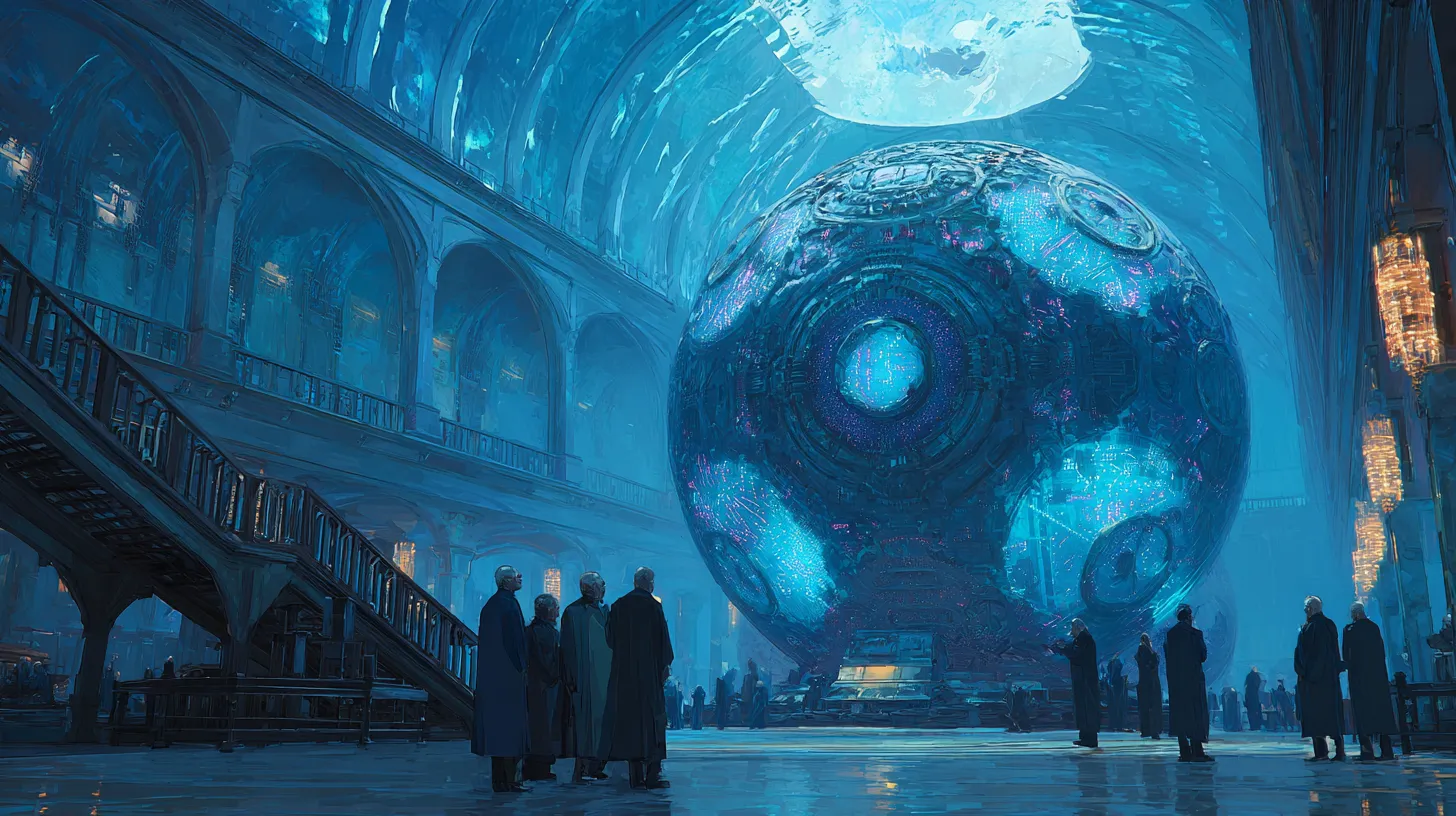
Gaal Dornick has the distinction of being the most heavily reinvented character in the Apple TV+ adaptation of Foundation. In Isaac Asimov's original novel, she is a minor figure who appears in the first chapter and is never seen again. In the television series, she is the protagonist — the character whose perspective anchors the entire three-season story.
This is not a criticism of the show. It is an observation about what adaptation requires. The Foundation novels are, by deliberate design, not built around individual characters. Asimov's genius was his ability to tell a story where civilizations are the protagonists and individual people are illustrative examples. Television requires faces. The show needed a protagonist who could persist across centuries, and Gaal Dornick — already on the page at the opening of the story — was available.
What the show did with her is one of its most interesting creative choices. Let's look at both versions clearly.
Gaal Dornick in the Books
In Foundation (1951), Gaal Dornick is a young mathematician from the planet Synnax who wins a competition to come to Trantor and work with Hari Seldon. He (the book version is male) arrives on Trantor, is immediately awed by the planet-city, watches Seldon's trial, and witnesses the Foundation's establishment.
That's essentially it. Gaal appears in approximately one chapter, called "The Psychohistorians." He is a narrative device: a newcomer whose wonder at Trantor gives Asimov a reason to describe the city, whose confusion about the trial gives Asimov a reason to explain it. He is a camera, not a character.
After "The Psychohistorians," the book jumps forward 50 years and follows entirely different people. Gaal is mentioned briefly as "the first leader of the Foundation" in one reference, but never appears again.
This is typical of Asimov's Foundation novels. Characters are introduced, used to dramatize a specific historical moment, and then replaced by the next generation. The continuity is in the Foundation and the Plan, not in the people.
What the TV Show Changed
The Apple TV+ series, created by David S. Goyer, made Gaal Dornick female (played by Lou Llobell) and radically expanded her role. In the show, Gaal is not just present at the Foundation's creation — she becomes, over the course of three seasons, the story's emotional and thematic center.
The key invention is cryosleep. In the show, Gaal is placed in an escape pod that drifts through space for 138 years after Raych Seldon kills Hari and ejects her. She then awakens in a changed galaxy, and later chooses to go into cryosleep again to face the Mule 152 years further in the future.
This device solves television's central adaptation problem: it allows a single character to span three centuries without requiring the story to establish new protagonists every season. Gaal can be in Season 1 (the founding), Season 2 (150 years later), and Season 3 (300 years later) without any narrative contradiction.
The cost is that this Gaal is an invented character, not a faithful adaptation. The show's Gaal is psychically gifted, emotionally conflicted, and increasingly aware that she may be the Seldon Plan's most critical element. None of this is in the books.
The Psychic Abilities
The most controversial addition to TV-Gaal is her precognitive ability. In the show, Gaal can sense future events — she has prophetic visions and can "see" patterns in probability that others cannot. By Season 2 and 3, this has become the show's version of Second Foundation mentalics.
In the books, Gaal Dornick has no such abilities. He is a mathematician — gifted, yes, but purely analytically. The insight that something other than math might be needed to maintain the Seldon Plan is part of the books' Second Foundation arc, but it's handled institutionally, not personally.
The show's choice to make Gaal psychically gifted serves two purposes: it gives her a narrative superpower that justifies her importance, and it begins the show's long-running thread about the relationship between mathematical prediction and psychic intuition. Whether this works depends on your tolerance for mysticism in what Asimov designed as a rationalist universe.
My view: the psychic abilities are the weakest element of the show's Gaal. They work against what makes psychohistory interesting — the argument that prediction doesn't require mysticism, that pure mathematics is sufficient. When Gaal "sees" things that her equations don't quite explain, the show gestures toward a spiritual dimension that Asimov deliberately avoided.
What the Show Gets Right About Gaal
The show's Gaal does capture something real from the original character: the experience of being an outsider confronting a world vastly larger than expected.
Book-Gaal arrives on Trantor from a provincial planet and is immediately overwhelmed by the scale of the planet-city. He is not stupid — he won a mathematics competition to get here — but he is provincial, and Trantor makes him feel provincial. This is the emotional truth of the character's first chapter.
TV-Gaal carries this quality across three seasons. She is perpetually the person who understands the mathematics but is still catching up with the political and emotional realities. Lou Llobell plays her with a consistent quality of careful, slightly overwhelmed intelligence — she's always the smartest person in the room, but the room keeps changing.
The relationship between TV-Gaal and Hari Seldon (Jared Harris) is also more developed than anything in the books, and is genuinely moving. Harris's Seldon is a tired, morally serious man who has spent his life building something that will outlast him, and his recognition of Gaal as someone who might sustain it carries emotional weight the novels don't attempt.
Which Version Works Better?
This is an unfair comparison, because they're doing completely different things.
Book-Gaal works perfectly for what the book needs: a window into the Foundation's creation, a way to make Seldon's trial feel like an event rather than a description. He's a good camera.
TV-Gaal works for what the show needs: a human face and consistent perspective across three centuries of galactic history, someone whose growth and suffering and choices give the abstract history emotional stakes. She's a good protagonist.
The book's Gaal is not a mistake; Asimov didn't forget to develop him. The books' genius is precisely that individuals are expendable — you care about the Foundation, not about any particular person in it. The show's genius is precisely that individuals are everything — you care about Gaal, and through her, you care about the Foundation.
These are genuinely different artistic visions. Both are legitimate. The adaptation didn't betray the source material; it translated it into a different medium with different requirements, and invented what it needed.
What it lost, and what only the books can give you, is the vertiginous sensation of watching history happen without any protagonist — just forces, crises, solutions, and time.