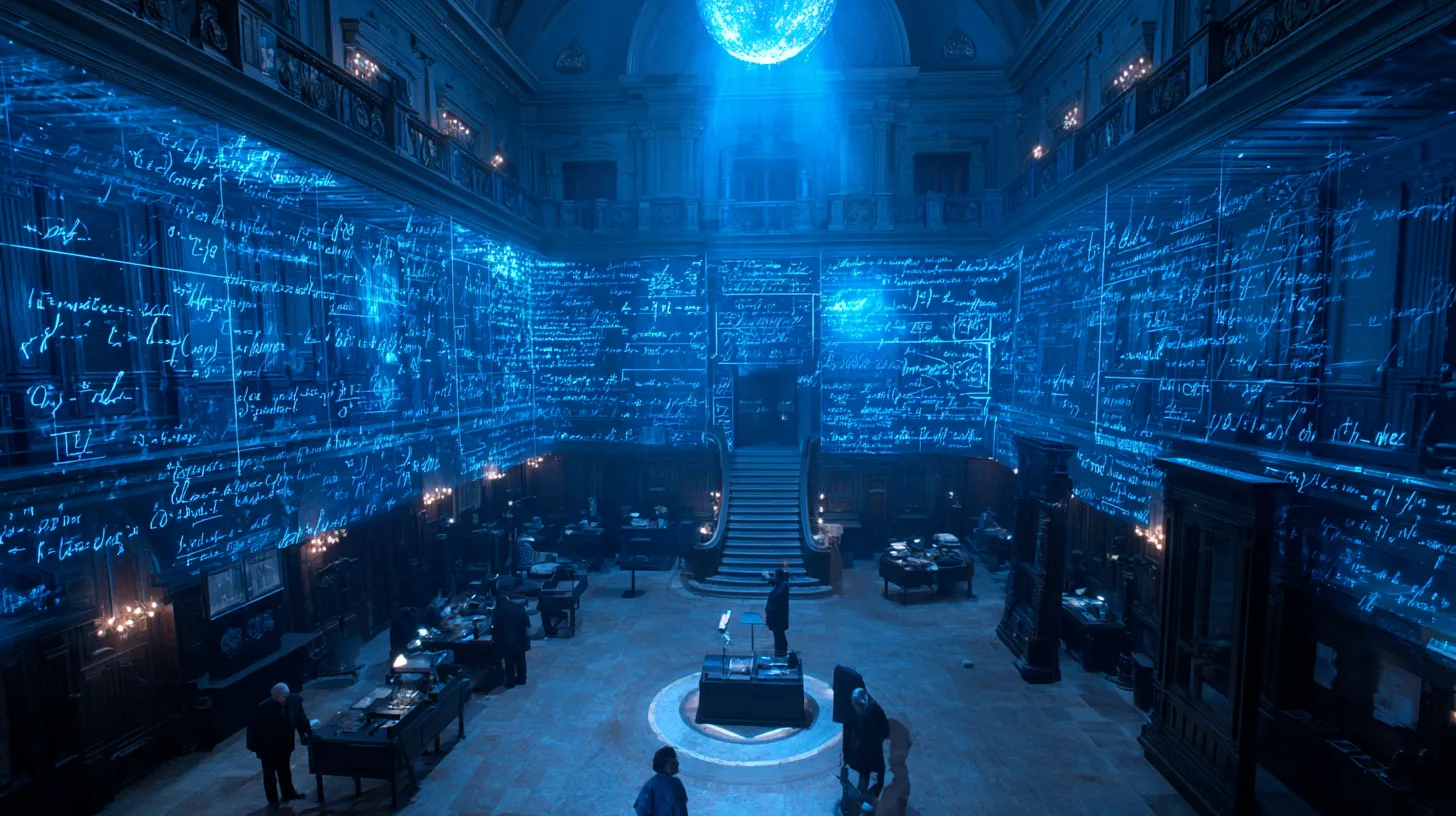
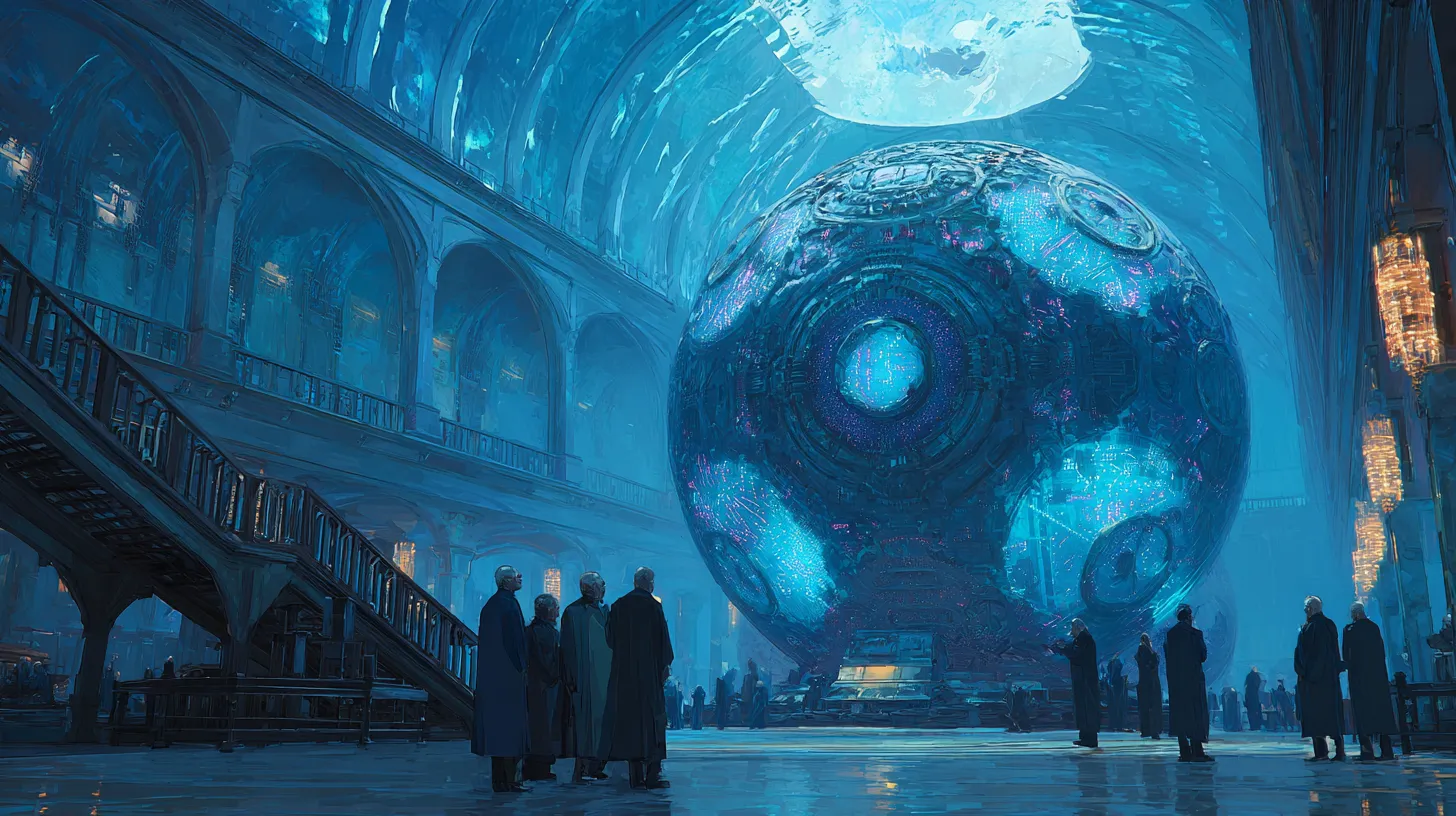
There is a standard way of reading the Foundation series, and it goes like this: Hari Seldon invents a mathematics that can predict the future of civilizations, and uses it to save humanity from thirty thousand years of darkness. Psychohistory is the hero of the story: the triumph of reason over chaos. Paul Krugman has said the series inspired him to become an economist, because economics was the closest real discipline to Seldon's science. A generation of technologists and forecasters cite it the same way: wouldn't it be extraordinary if we could actually do that?
This reading gets the plot right and the meaning wrong.
Go back to the books and pay attention to what psychohistory actually does: not what it's said to be, but how it operates, chapter by chapter. What you find isn't a science of prediction. It's a system of control that uses prediction as one of its instruments. And once you see that, the Foundation series stops being a fantasy about forecasting the future and becomes something far more uncomfortable: the most prescient description ever written of the machinery we've spent the last two decades building.
The Rule Everyone Forgets: The Predicted Must Not Know
Psychohistory rests on two famous conditions. The first is innocent enough: the population must be huge, large enough to behave statistically. The second gives the game away: the population being predicted must remain ignorant of the predictions. If people learn what the equations say they'll do, they change their behavior, and the mathematics collapses.
Think about what this actually means in practice. It means psychohistory is not, and can never be, a public science. There is no version of the Seldon Plan that gets published in a journal, debated by citizens, and voted on. Secrecy isn't a regrettable side effect of the Plan. It is a load-bearing requirement. The science only functions as an information asymmetry: a small group who can see the model, and billions who must not.
Asimov dramatizes this with an institution that deserves more scrutiny than fans usually give it: the Time Vault. Seldon's hologram appears on Terminus on a schedule fixed centuries in advance, telling the Foundation what he predicted, but only after each crisis has already been resolved. The information is released precisely when it can no longer change anything. That's not education. That's disclosure management, timed by an actuary who has been dead for generations.
The Plan's beneficiaries never consented to it. They can't; consent would break it. This is the bargain at the heart of the series, stated plainly nowhere and operating everywhere: your future has been arranged for your own good, by people you will never meet, using a model you are not permitted to see.
The Second Foundation Is Not a Research Institute
The standard reading treats the Second Foundation, the hidden colony of psychohistorians at "Star's End," as the Plan's maintenance crew, quietly keeping the math up to date. But look at what their actual work consists of in Second Foundation: they are not primarily mathematicians. They are mentalics, trained manipulators of individual human minds.
When reality deviates from the Plan, the Second Foundation does not sit down and recompute the equations. It identifies the specific people whose decisions matter and adjusts them. A nudge to an official's emotional state here. A conviction quietly implanted in a general there. In the Arkady Darell storyline, the Second Foundation's response to being discovered is a long, patient deception: a teenage girl whose mind was adjusted in infancy, a trail of planted clues, and fifty of its own members handed over for capture, all so that the First Foundation will believe a comfortable lie and go back to sleep.
This is the part of psychohistory that the "science of prediction" framing conveniently forgets: in Asimov's own account, prediction alone was never enough. The Plan drifts. The equations err. And the gap between the predicted future and the real one is closed, every single time, by intervention in human minds — performed secretly, on people who didn't agree to it, by an institution accountable to no one.
Prediction and control are not two functions of psychohistory. They are one function. The model tells you which minds to edit; the editing keeps the model true.
We Built the Same Machine, and It Runs on Engagement
Now hold that structure up against the systems that mediate most of what humanity reads, watches, and believes in 2026.
A recommendation algorithm is, formally, a prediction engine: it estimates what you are likely to click, watch, or share. But nobody deploys a prediction engine to observe. The prediction is deployed to cause the predicted behavior — to select, from everything that could reach you, the item most likely to produce the response the operator wants. At scale, a system that predicts human behavior and a system that steers human behavior are the same system. This is the psychohistorical two-step, automated: model the population, then arrange its informational environment so the model comes true.
And like the Seldon Plan, it runs on the ignorance requirement. The models are proprietary. The feed looks like the world, not like a curated intervention. You cannot see the ranking function that decided what you'd encounter today, and the operators have every incentive to keep it that way — an audience that fully understood the machinery would behave differently, which is precisely what the machinery cannot afford.
The historical record here is short but instructive. In 2014, Facebook researchers published a study in which the platform deliberately altered the emotional balance of the feeds of roughly 689,000 users — more people than lived on Terminus — to test whether moods spread through networks. The measured effect was small, but the users were never asked; the experiment surfaced only because it was published. Four years later, the Cambridge Analytica scandal revealed that data harvested from up to 87 million profiles had been used to build psychological models for targeted political persuasion. Whether that operation actually swung anything remains disputed. What's not disputed is the ambition: a private organization assembling population-scale behavioral models to steer democratic outcomes, invisibly, one profiled mind at a time.
Small effect sizes are the honest caveat — and the wrong comfort. The Second Foundation never needed to control everyone either. The lesson of both the fiction and the scandals isn't that mass mind-control works; it's that the architecture (hidden models, asymmetric information, populations managed without consent) gets built long before anyone proves it works, and doesn't get dismantled when the effects turn out to be modest.
The Mule Was a Warning About Exactly This
Foundation fans remember the Mule as the great exception: the mutant whose individual powers broke the Plan because psychohistory can't predict outliers. That's true. But notice what his power is: the Mule doesn't out-argue anyone, doesn't out-fight anyone, doesn't present better evidence. He adjusts emotions directly. His victims don't feel coerced. They feel genuinely loyal, enthusiastic, converted. The horror, as Asimov writes it, is that from the inside, manipulation is indistinguishable from sincere feeling.
Strip away the mutation and the Mule is a familiar figure: he is engagement optimization with a face. A mechanism that bypasses argument and operates directly on feeling, producing followers who experience their captured attention as authentic desire. Asimov built his greatest villain out of the exact capability that his heroes, the Second Foundation, use routinely and are praised for. The only difference is branding: when the Mule edits a mind, it's monstrous; when a Speaker does it, it's stewardship.
Asimov knew what he was doing with that symmetry. The books repeatedly stage the same question, is benevolent manipulation still manipulation?, and then quietly refuse to let the reader off the hook.
Asimov Kept Pulling Back the Curtain, and It Got Darker Every Time
Here's the strongest evidence that the control reading is the intended one: the structure of the entire saga is a series of reveals, and every reveal exposes a deeper, less accountable controller.
First we learn the Foundation isn't humanity's bold experiment but a pawn in Seldon's design. Then we learn the real custodians are the hidden Second Foundation, editing minds to keep the Plan on track. Then, in the late novels, we learn that behind them stands R. Daneel Olivaw, a robot who has been covertly steering human history for twenty thousand years under a self-authorized ethical theory (the Zeroth Law) that no human ever ratified. And Daneel's final project, Galaxia, would join individual minds into a single galactic consciousness, the ignorance requirement solved forever, because there would no longer be anyone separate enough to be deceived.
Each layer is introduced as a comfort (don't worry, someone wise is in charge) and lands as a deeper unease. By Foundation's Edge, Asimov gives that unease a voice: Golan Trevize, whose entire narrative function is to be the man who distrusts the arranged future, chooses Galaxia and then spends the whole of Foundation and Earth trying to justify his own choice. The series' emotional center of gravity shifts, book by book, away from the planners and toward the people trying to stay unplanned.
That trajectory is not the shape of a story that admires its predictors. It's the shape of a warning that its author kept sharpening for forty years.
The First Laws Against Psychohistory
One measure of how real all this has become: we have started writing laws against it.
The EU AI Act, whose prohibitions have applied since February 2025 and most of whose remaining rules apply from August 2026, opens its list of banned practices with systems that deploy "subliminal" or "purposefully manipulative" techniques to distort human behavior, and systems that exploit psychological vulnerabilities to steer decisions. Read those clauses with Foundation eyes and they are startlingly specific: they are anti-Mule statutes. Anti-Speaker statutes. The first attempt in legal history to prohibit, by name, the core operating methods of the Second Foundation.
Whether the enforcement matches the ambition is an open question. As we covered in our analysis of the Three Laws and real AI, external rulebooks are what humanity built after discovering that internal laws don't hold. But the legislative fact itself concedes the argument: the machinery of prediction-as-control is no longer science fiction, because you don't ban things that don't exist.
Read It Again From the Bottom
None of this makes psychohistory a bad dream or Asimov a prophet of doom. The Foundation series is genuinely ambivalent. It loves the elegance of the Plan even as it counts the cost, which is exactly why it's worth rereading instead of merely citing. (For the prediction side of the ledger, what the real science of forecasting can and can't do, see our companion piece on psychohistory and real-world science.)
But if you've only ever read Foundation from Seldon's chair, the view from the observatory where humanity is a gas whose pressure can be computed, try reading it once from the bottom. From inside the crowd on Trantor that doesn't know it's a variable. From Terminus, waiting for a dead man's hologram to explain what your life was for. The series looks different from down there, and 2026 looks different after it.
The question Asimov left us was never can a science of society be built? Half of it already has been. It ranks your feed, prices your attention, and models your next decision right now. The question he actually posed, and never let his heroes fully answer, is the one that matters: who gets to be Seldon, and who has to live inside his Plan?