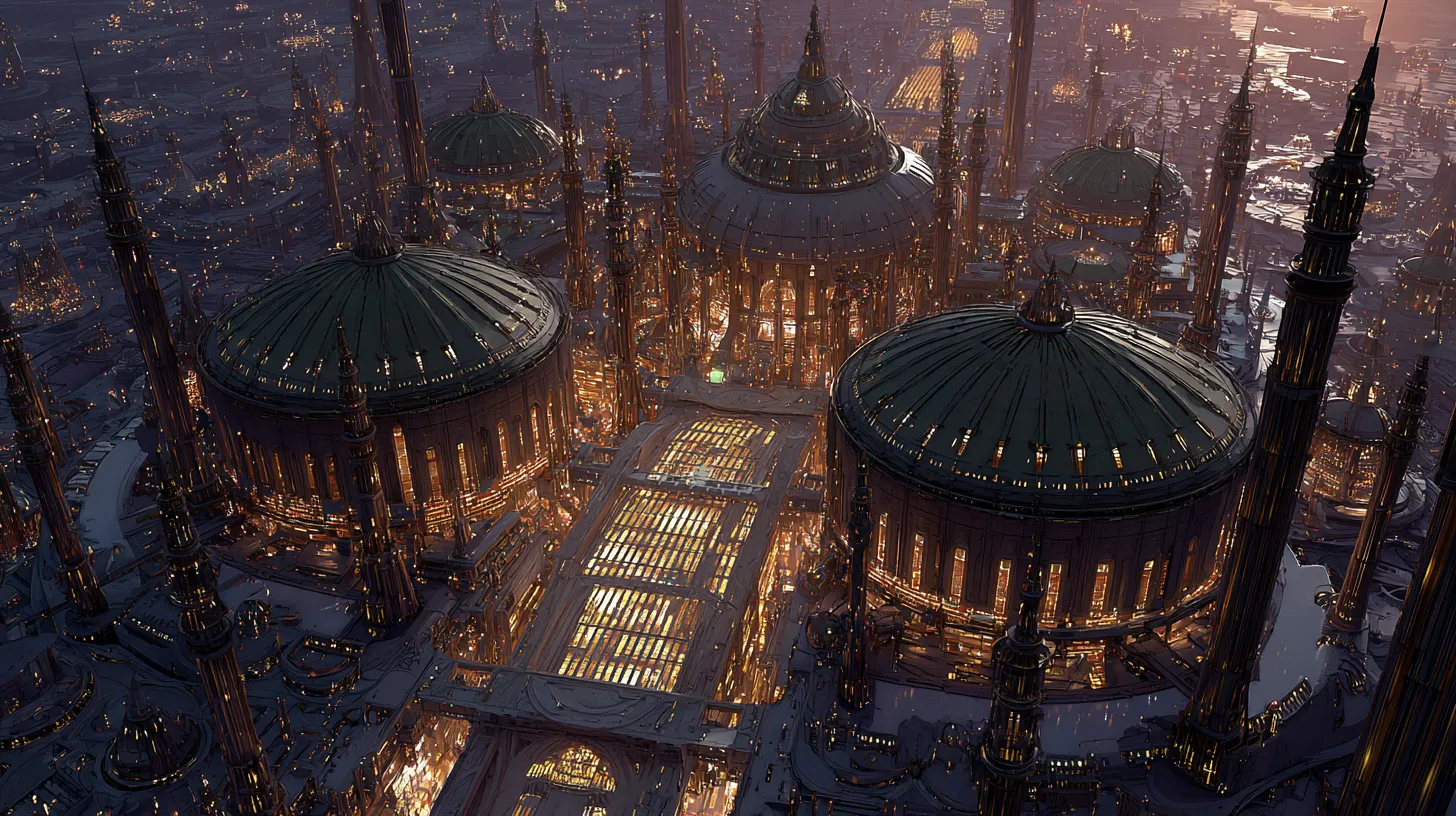
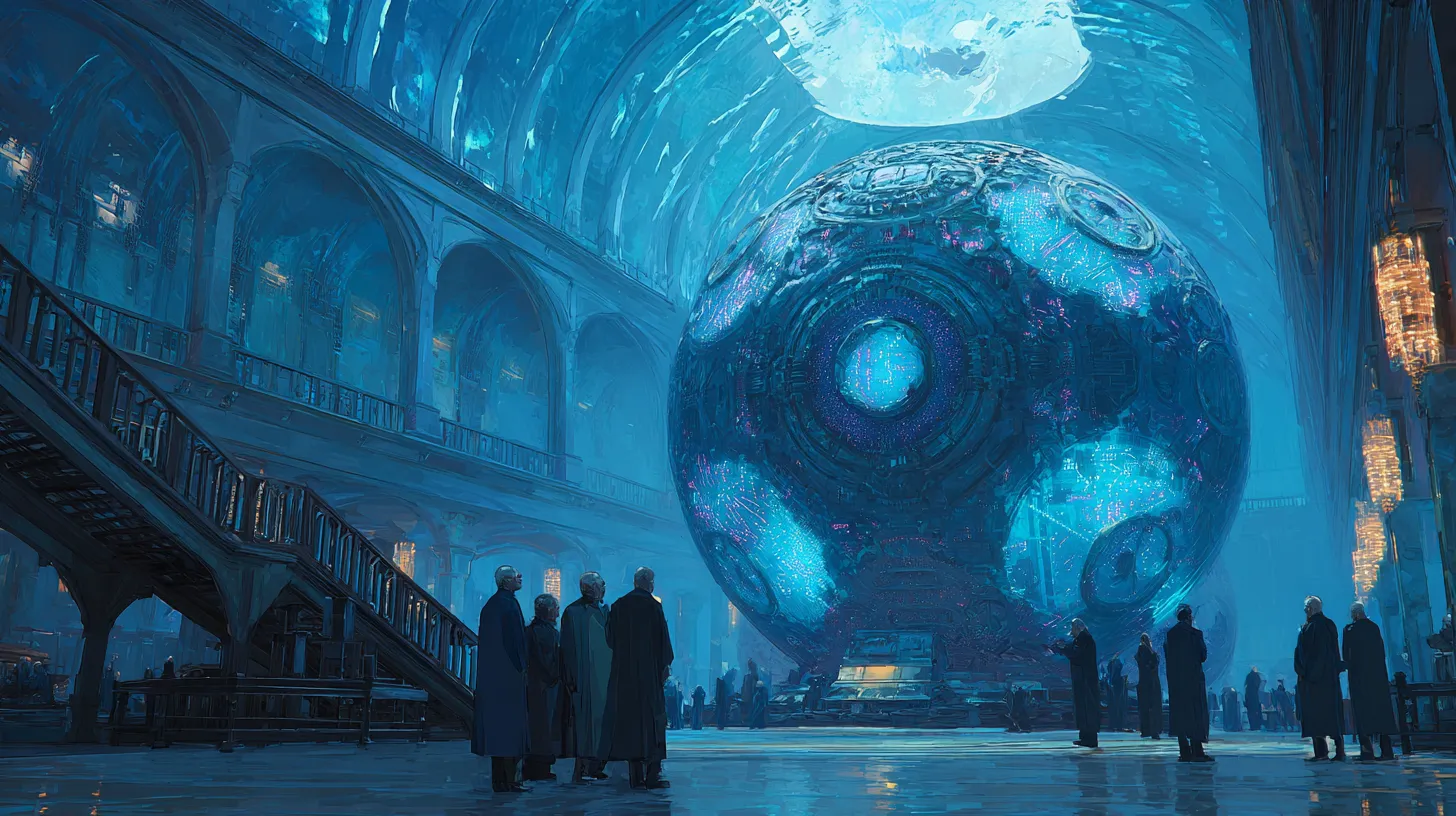
Imagine a planet where every square meter of surface is covered by metal. Where 40 billion people live beneath a single roof. Where 20 agricultural worlds exist solely to feed one city. Where the entire government of 25 million inhabited worlds operates from underground corridors that stretch for thousands of kilometers.
This is Trantor, Isaac Asimov's most famous creation after psychohistory itself.
A Planet-Wide City
Trantor is an ecumenopolis: a planet entirely covered by a single city. In the Foundation novels, it sits near the center of the Milky Way galaxy, serving as the administrative capital of the Galactic Empire for over 12,000 years.
The statistics are staggering:
- Population: 40 billion people (at peak)
- Land area: 75 million square miles (about 194 million km²) by the Encyclopedia Galactica's figures, almost entirely built over
- Sky access: The Imperial Palace grounds are the famous exception to the metal roof
- Food supply: Entirely imported from 20 dedicated agricultural worlds
- Heat management: Massive cooling systems manage the waste heat generated by 40 billion people and their technology
Trantor's population never goes outside. The entire surface is metal-clad, with the sky visible only from a few privileged locations. Most Trantoreans live their entire lives underground, in a maze of corridors, apartments, offices, and transit systems that make the city navigable despite its mind-boggling scale.
Asimov's Inspiration
Asimov drew direct inspiration from ancient Rome when creating Trantor. Rome, at the center of the Roman Empire, grew far beyond its ability to feed itself and depended on grain from Egypt and North Africa. Trantor takes that imperial dependence to its logical extreme.
But Asimov also drew from his own experience. Born in Russia and raised in Brooklyn, New York, Asimov was a lifelong urbanite who professed a love of enclosed spaces. While many science fiction writers imagined humanity among the stars, Asimov imagined humanity underground — sealed away from the natural world, choosing order and efficiency over wilderness.
The concept of an ecumenopolis was not new to Asimov (the term was coined by geographer Constantinos Doxiadis in the 1960s), but no one had imagined it on such a scale or with such rigor. Trantor became the template for planet-cities in science fiction, and Coruscant in Star Wars is the example most often compared to it.
Trantor Through the Ages
The Rise (Pre-Foundation Era)
Trantor's growth from a single-world civilization to the galactic capital took thousands of years. The Empire novel The Currents of Space (1952) shows Trantor as a growing political power, not yet fully urbanized, already accumulating influence over neighboring star systems.
By the time of the Foundation prequels, Trantor is at its peak. In Prelude to Foundation (1988), Asimov gives us the most detailed tour of the planet, as young Hari Seldon travels through its diverse sectors:
- Streeling University: The academic quarter, relatively orderly and intellectual
- Mycogen: A secretive religious community whose rituals preserve garbled memories of the Spacer world Aurora, and whose micro-farms feed much of the planet
- Dahl: The working-class sector, where heat-sinkers maintain the cooling systems and social tension runs high
- Wye: A wealthy sector whose Mayor harbors secret ambitions for the Imperial throne
Each sector has its own culture, dialect, and customs, which makes Trantor feel less like a single city than like hundreds of nations under one roof.
The Decline (Foundation Era)
By the time of the original Foundation novel (1951), Trantor is already in decline, though it doesn't know it yet. Hari Seldon's psychohistory reveals what the politicians refuse to see: the Empire's bureaucracy is calcifying, initiative is dying, and the outer provinces are drifting away.
The specific signs of Trantor's decline include:
- Rising bureaucracy: More administrators, fewer doers
- Supply chain fragility: Any disruption to the 20 agricultural worlds would starve the planet
- Knowledge decay: Peripheral worlds are losing technology; Trantor's own sciences are stagnating
- Political paralysis: The Emperor's power is increasingly nominal; the real power lies with bureaucratic factions that block all reform
Seldon's trial — where he publicly predicts the Empire's fall — takes place on Trantor. The establishment's refusal to engage with his mathematics is itself evidence of the decline he predicts.
The Sack of Trantor
The fall itself happens offstage, between the two halves of Foundation and Empire (1952). During the civil wars that finish the Empire, Trantor suffers the Great Sack, and its forty billion people are reduced to a fraction. The agricultural worlds stop sending food. The infrastructure collapses.
In Second Foundation (1953), Trantor has become a world of farmers: most of the planet-city abandoned and rusting, with a small population growing food on land cleared of its metal covering. The irony is exquisite: the planet that couldn't feed itself becomes agrarian.
This is also where the Second Foundation hides, "at Star's End." Seldon's phrase is a brilliant misdirection: it doesn't mean the edge of the galaxy but the old heart of the Empire, where every star once ended up as an entry in the Imperial records. What better hiding place than the ruins of the Empire's capital, where no one would think to look?
The Apple TV+ Version
The Apple TV+ adaptation depicts Trantor with breathtaking visual ambition. The Star Bridge, a space elevator connecting Trantor to orbit, is an original addition that gives the planet-city a dramatic visual anchor. Its destruction in Season 1, blamed on Anacreon and Thespis and later revealed as Demerzel's doing, is one of the show's most spectacular sequences, with no equivalent in the books.
The show's Trantor emphasizes the contrast between the opulent Imperial Palace (open to the sky) and the cramped underlevels where billions live in shadowed corridors. This visual hierarchy, light for the powerful and darkness for the masses, captures Asimov's vision of an empire that looks grand from above but is rotting from within.
Common Misconceptions About Trantor
"Trantor is the same in the books and the television series." The central idea is shared: both versions present a planet-wide capital whose scale hides institutional decline. The Star Bridge, the three cloned emperors, and the show's elaborate spaceport are adaptation inventions. In the novels, the clearest portrait of daily life comes from Hari Seldon's travels through culturally distinct sectors in Prelude to Foundation.
"Every part of Trantor is sealed under metal." Almost all of the inhabited surface is enclosed, but the Imperial Palace grounds remain open to the sky. Mycogen also preserves unusual agricultural and cultural spaces beneath its domes. These exceptions matter because access to nature has become a privilege or a carefully guarded tradition.
"Trantor falls as soon as Hari Seldon predicts it." Seldon predicts a long imperial collapse, not an immediate explosion. The Empire continues for centuries after his trial, losing control unevenly while its capital still projects wealth and permanence. Trantor's eventual sack confirms the mathematics long after the political establishment that rejected Seldon is gone.
"The Second Foundation chose Trantor only because it was abandoned." Concealment was useful, but Trantor was also the galaxy's old intellectual center. Its surviving Imperial Library gave the Second Foundation access to records and a believable institutional shelter, while the clue "at Star's End" pointed to the symbolic center of the former Empire rather than a remote galactic edge.
Where Trantor Appears in the Books and Show
Trantor first appears during the Empire's expansion in The Currents of Space. It dominates the opening of Foundation, where Gaal Dornick arrives for Hari Seldon's trial, and it becomes a fully explored world in the prequels Prelude to Foundation and Forward the Foundation. Its ruined, agrarian afterlife, and its role as the hidden home of the Second Foundation, are central to Second Foundation.
Apple TV+'s Foundation uses Trantor throughout its imperial storyline. The series makes the capital the visual home of the Genetic Dynasty and dramatizes its vulnerability through the destruction of the Star Bridge. Those events are not in the novels, but they translate Asimov's central point into television: a system can look invulnerable while depending on structures that cannot absorb a serious shock.
Trantor's Real-World Parallels
Asimov deliberately modeled Trantor on historical examples of overgrown capitals:
Rome (1st to 5th century AD): probably the largest city of the ancient world, fed by grain shipped from Egypt and North Africa. As the western Empire came apart and those supply lines failed, the city's population collapsed.
Modern megacities: Tokyo, Lagos, and Mexico City hold tens of millions of people and import almost all their food from far away. None faces Trantor's extreme, but the dependence of a great city on distant farms is the same pattern.
Trantor as a Warning
Asimov was not anti-urban. He loved cities. But Trantor represents a warning about what happens when a civilization prioritizes efficiency and control over resilience and adaptability.
Trantor is the perfect administrative machine, until it isn't. Its single point of failure, food imports, makes it astonishingly fragile. Its sealed-off population loses the skills, knowledge, and psychological flexibility needed to adapt when catastrophe comes. Its bureaucracy optimizes for stability, which is another word for stagnation.
The parallel to modern civilization is uncomfortable. Our global supply chains are more interconnected than ever. A pandemic, a war, or a climate shock can ripple through systems designed for efficiency, not resilience. Trantor didn't plan for the day the grain ships would stop coming. Do we?
The Heart of Everything
Trantor is more than a setting. It's Asimov's central metaphor for civilization itself: magnificent, fragile, and inevitably temporary. It rises from nothing, grows to encompass a galaxy, and falls because the very systems that made it great also made it brittle.
And yet, in its ruins, the Second Foundation perseveres, a small group of scholars preserving the knowledge needed to build the next civilization. The ruins of Trantor become the seed of renewal.
In the end, Trantor is Asimov's answer to the question that drives the entire Foundation series: what survives the fall of a great civilization? Not the buildings, not the bureaucracy, not the power. Only the knowledge, and the people who carry it.