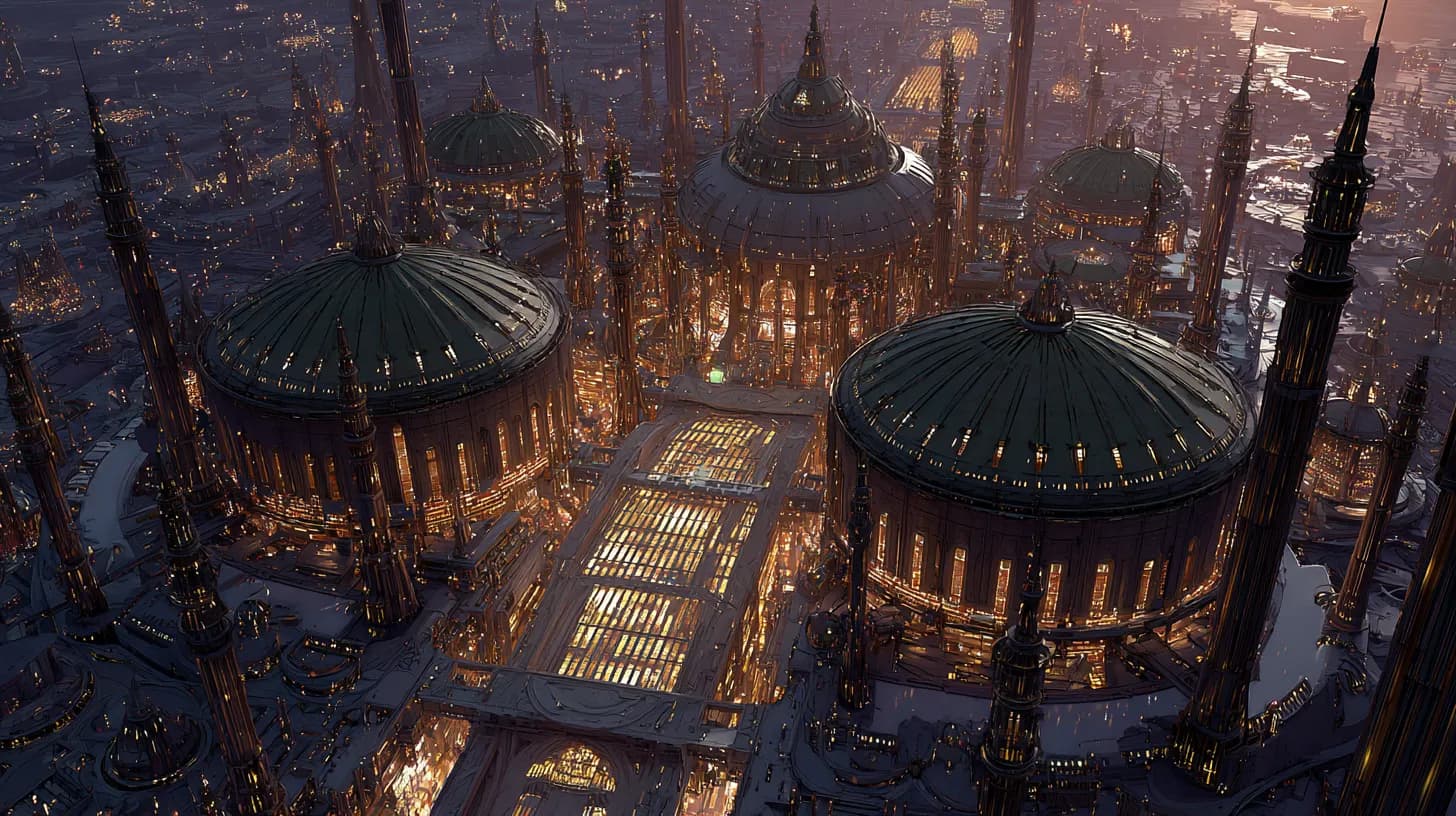
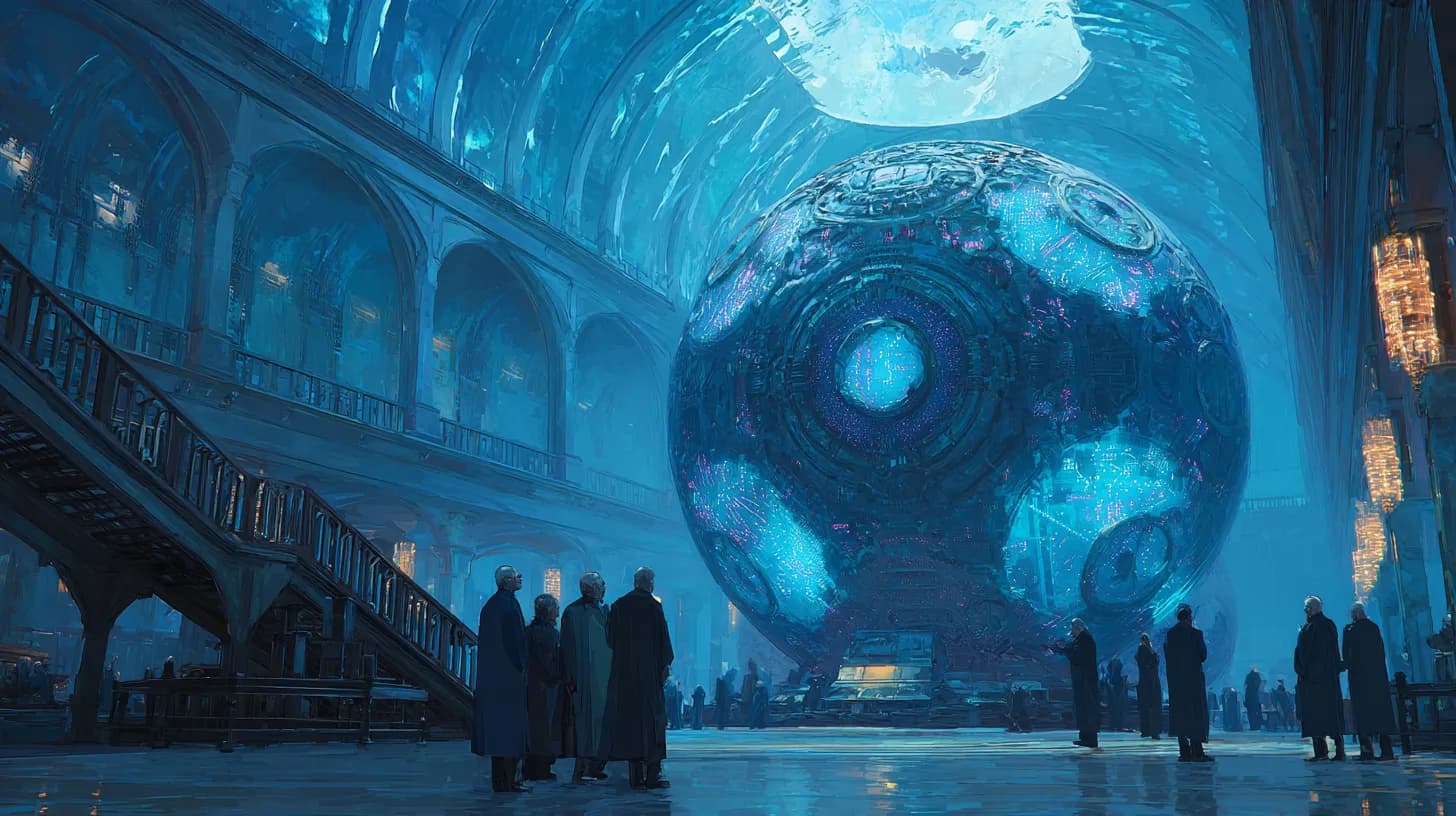
For twelve thousand years, Trantor was more than just a planet; it was the administrative pulse of a galaxy-spanning civilization. As the capital of the Galactic Empire, it represented the pinnacle of human achievement and, ultimately, the hubris that would lead to the long night.
Encyclopedia Galactica
TRANTOR... The capital of the First Galactic Empire. At the height of its power, it was an ecumenopolis, a city-planet, with a population of 40 billion, devoted almost entirely to the administration of the Empire.
The Ecumenopolis
Imagine a world where nature has been entirely subsumed by steel, glass, and humanity. Trantor was an ecumenopolis—a planet-wide city. Its entire surface of 194 million square kilometers was enclosed under immense metal domes, shielding its inhabitants from the weather and creating a perfectly controlled environment.
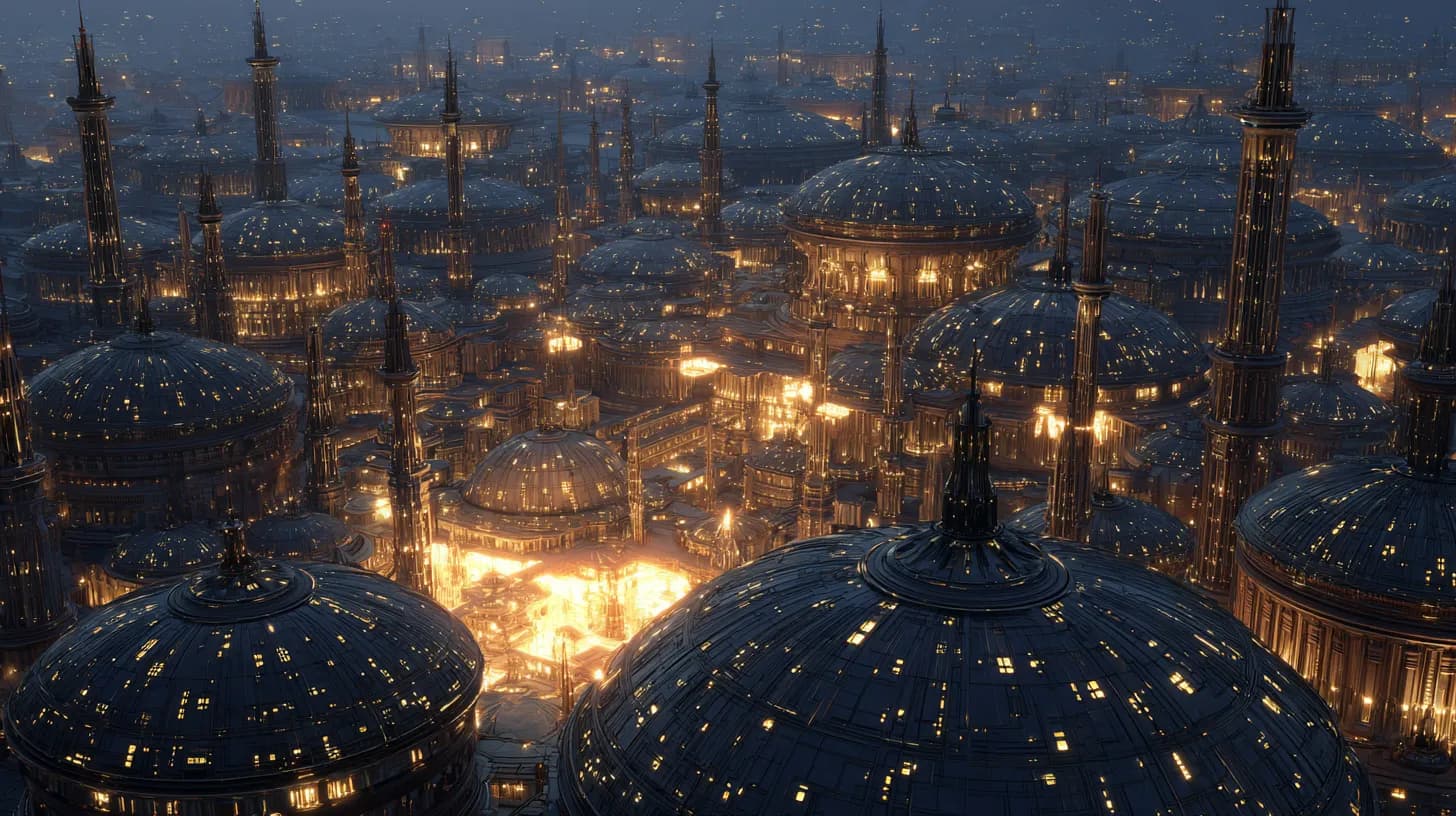
The population of Trantor stood at a staggering 40 billion. These billions were not farmers or manufacturers; they were bureaucrats, scholars, and functionaries. Trantor produced nothing but laws, decrees, and order. It was entirely dependent on the "Outer Worlds" for food and resources, with thousands of ships arriving daily to feed the insatiable hunger of the capital.
Life Beneath the Domes
Life on Trantor was stratified, literally and metaphorically. The closer one lived to the Imperial Palace and the surface, the higher one's status. Deep beneath the surface lay the "Heatsinks," massive geothermal power stations where millions toiled to keep the city running.
Despite its artificiality, Trantor was not without beauty. The Imperial Library was the repository of all human knowledge, and the Imperial Palace grounds were vast enough to contain gardens, mountains, and seas—all artificial, yet perfect.
Dependency Vulnerability
The fatal flaw of Trantor was its absolute reliance on external supply lines. A siege of Trantor did not require weapons; it merely required a blockade. When the Empire began to fracture, this dependency turned the capital into a tomb.
The Fall
Hari Seldon, the founder of Psychohistory, foresaw the fall of Trantor centuries before it happened. He predicted that the complex systems holding the Empire together would degrade, leading to rebellion, chaos, and the eventual sacking of the great library.
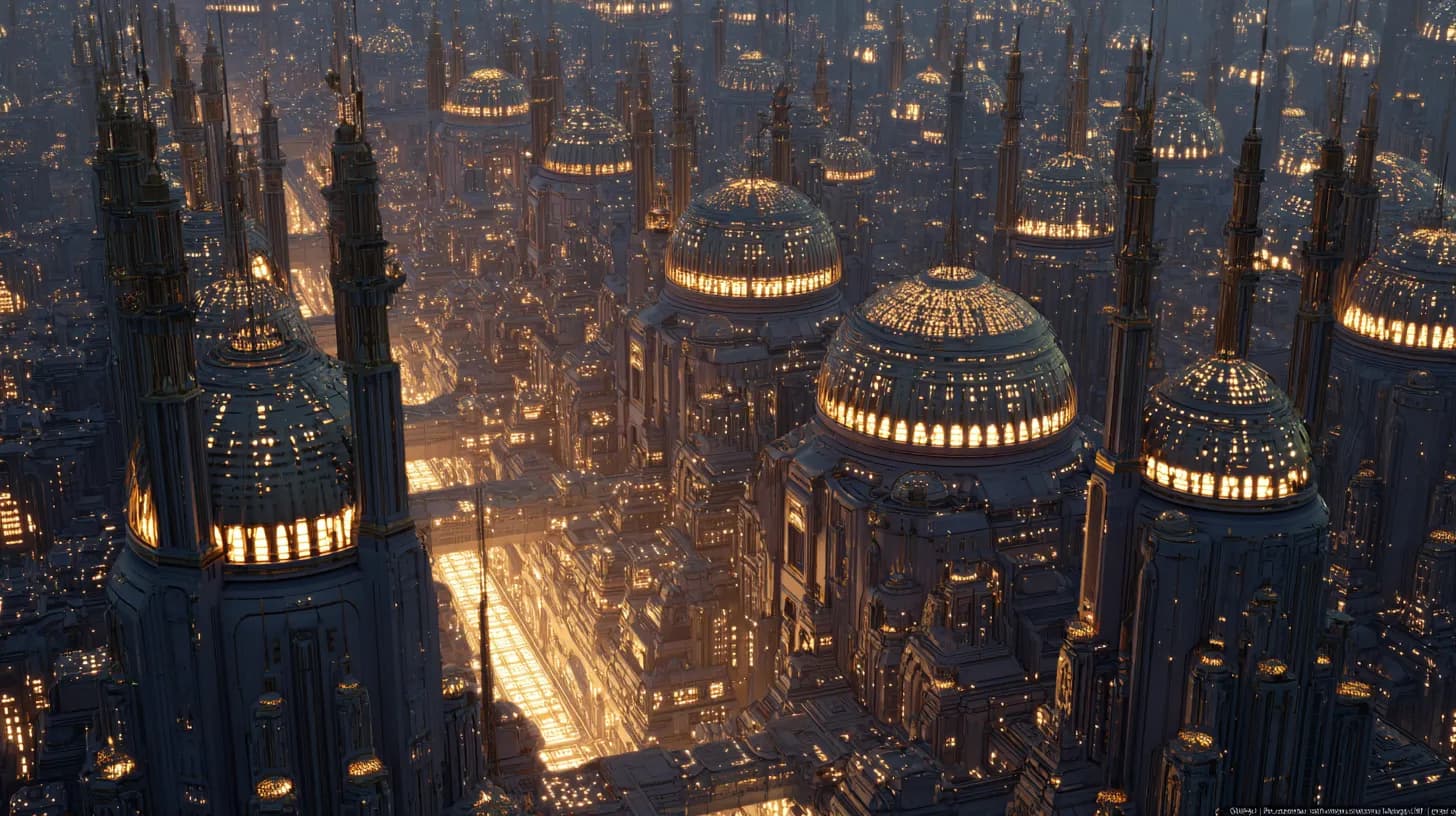
The "Great Sack of Trantor" by the rebel Gilmer marked the definitive end of the Galactic Empire. The metal domes were breached, the heating systems failed, and the billions who could not flee perished. The once-great capital was reduced to an agrarian backwater, its survivors tearing up the metal plates to plant crops in the soil beneath. They eventually renamed their world "Hame" (Home), forgetting the glory that once was.
Trantor serves as a powerful reminder: no matter how high we build, any civilization built on fragile foundations is destined to crumble. Its story echoes the decline of the Roman Empire, which Asimov acknowledged as his primary inspiration in his autobiography I. Asimov: A Memoir.
Trantor's Influence on Science Fiction
Trantor's concept of the ecumenopolis — an entire planet covered by a single city — has become one of science fiction's most enduring ideas. George Lucas adapted it as Coruscant in the Star Wars prequel trilogy, a planet-wide capital city that serves the Galactic Republic in precisely the same administrative role Trantor served Asimov's Empire. Lucas has acknowledged Asimov's influence, and the visual parallels are unmistakable.
The concept has also inspired real urban planning discussions. Researchers at institutions like the Santa Fe Institute have studied the mathematical scaling laws of cities — finding that as cities grow, they become both more productive and more fragile, echoing Trantor's fate. The larger the system, the more catastrophic its failure mode.
Trantor in the Apple TV+ Adaptation
Apple TV+'s Foundation series (2021–2025) brought Trantor to life with stunning visual effects. The show's Trantor features towering spires, the Star Bridge space elevator, and the Imperial Palace — all rendered with a visual grandeur that critics praised as some of the best sci-fi production design on television.
The show's most significant Trantor-related invention is the Genetic Dynasty — three clones of Emperor Cleon (Dawn, Day, and Dusk) who rule simultaneously. This concept does not exist in Asimov's novels, where different emperors succeed each other normally. The Dynasty's storyline, led by Lee Pace as Brother Day, became one of the show's most acclaimed elements, exploring questions of identity, individuality, and what it means to rule through genetic repetition.
The Lessons of Trantor
Trantor's story carries warnings that remain relevant today. Its absolute dependence on global supply chains mirrors modern concerns about supply chain vulnerability. During the COVID-19 pandemic, the world experienced firsthand how fragile interconnected systems can be when disrupted.
The planet's information overload — 40 billion bureaucrats producing increasingly meaningless paperwork — anticipated modern debates about institutional complexity, regulatory burden, and the point at which administration becomes a burden rather than a benefit. As Asimov wrote it, Trantor didn't fall to external enemies; it collapsed under the weight of its own complexity.
Frequently Asked Questions
What is Trantor in the Foundation series?
Trantor is the capital world of the Galactic Empire in Isaac Asimov's Foundation series. It is an ecumenopolis — a planet entirely covered by a single, continuous metal-domed city — with a population of approximately 40 billion. Trantor served as the administrative center of the Empire for over 12,000 years before its eventual sacking and decline.
How big is Trantor's population?
At its height, Trantor's population was approximately 40 billion people. The planet produced almost nothing physically — no food, no raw materials — and was entirely dependent on imports from thousands of agricultural worlds. An estimated 20 freighter shipments per second were required to feed the capital, making it extraordinarily vulnerable to disruption.
Is Coruscant from Star Wars based on Trantor?
Yes, the connection is widely acknowledged. George Lucas has cited Asimov's Foundation as an influence, and Coruscant — the planet-wide capital city of the Galactic Republic and later the Empire in Star Wars — closely mirrors Trantor's concept. Both are ecumenopolis worlds serving as the administrative and political center of a galaxy-spanning civilization.
What happens to Trantor after the Empire falls?
After the Empire's collapse, Trantor is sacked by a rebel fleet led by Gilmer. The metal domes are breached, heating systems fail, and most of the population perishes or flees. The survivors tear up the metal plating to expose soil for farming, and the world gradually reverts to an agrarian society. The inhabitants eventually rename their world "Hame" (meaning "Home"), forgetting its former glory. Ironically, Trantor's ruins become the secret headquarters of the Second Foundation.