Isaac Asimov was one of the most prolific writers of all time, having written or edited more than 500 books and an estimated 90,000 letters and postcards. Born in Petrovichi, Russia in 1920 and raised in Brooklyn, New York, Asimov transformed science fiction from pulp entertainment into a literary genre that explored humanity's deepest questions about technology, civilization, and the future.
The Big Three
Asimov was considered one of the "Big Three" science fiction writers during his lifetime, along with Robert A. Heinlein and Arthur C. Clarke. His most famous work is the Foundation Series, but his Robot series and the Galactic Empire series are also set in the same universe.
What set Asimov apart from his contemporaries was his focus on ideas over action. While Heinlein wrote about rugged individualism and Clarke explored cosmic wonder, Asimov's stories centered on intellectual problem-solving, the interplay between logic and human nature, and the long arc of civilizational change. His characters tend to be thinkers rather than fighters, and his plots unfold through dialogue and deduction rather than combat.
The Foundation Saga
Foundation
The Foundation series is a science fiction book series first published as a series of short stories in Astounding Science Fiction magazine in 1942–50, and subsequently in three collections in 1951–53. For thirty years the series was a trilogy: Foundation, Foundation and Empire, and Second Foundation. It won the one-time Hugo Award for "Best All-Time Series" in 1966.
"Violence is the last refuge of the incompetent." — Salvor Hardin
The Foundation series was directly inspired by Edward Gibbon's The History of the Decline and Fall of the Roman Empire. Asimov transposed the fall of Rome onto a galactic scale, asking: if you could predict the collapse of civilization using mathematics, could you also shorten the resulting dark age? This question became the premise for psychohistory and the entire Foundation saga.
The Robots
Asimov's Three Laws of Robotics — first formulated in his 1942 short story "Runaround" — became the most famous framework for robot ethics in all of fiction:
- A robot may not injure a human being or, through inaction, allow a human being to come to harm.
- A robot must obey the orders given it by human beings except where such orders would conflict with the First Law.
- A robot must protect its own existence as long as such protection does not conflict with the First or Second Law.
These laws have been discussed in real-world robotics research, AI ethics conferences, and even United Nations workshops on autonomous weapons. Asimov's exploration of the logical paradoxes inherent in these laws anticipated many of the ethical dilemmas now facing actual AI developers.
The Grand Unification
In the 1980s and early 1990s, Asimov undertook an ambitious project to connect his Robot, Empire, and Foundation series into a single continuous future history spanning approximately 20,000 years. Through novels like Robots and Empire (1985), Foundation's Edge (1982), and Foundation and Earth (1986), he revealed that the robot R. Daneel Olivaw had been secretly guiding humanity for millennia — a revelation that transformed the entire saga into one of the grandest narratives in science fiction.
Impact on Science and Culture
Asimov was a professor of biochemistry at Boston University. He was vice president of Mensa International for several years. The asteroid 5020 Asimov, a crater on the planet Mars, a Brooklyn elementary school, and a literary award are named in his honor.
Beyond these honors, Asimov's influence extends into real-world science and technology:
- Paul Krugman, Nobel laureate in economics, has stated that reading Foundation as a teenager inspired him to enter economics, drawn by the idea of predicting large-scale social phenomena mathematically.
- Elon Musk has cited the Foundation series as one of the works that inspired his vision of making humanity a multi-planetary species.
- The concept of psychohistory has influenced real academic fields such as cliodynamics, founded by Peter Turchin, which applies mathematical modeling to historical dynamics.
- The Encyclopedia Galactica concept anticipated Wikipedia and other collaborative knowledge projects by decades.
The Prolific Mind
Asimov's output was staggering. His bibliography spans virtually every category of the Dewey Decimal System. He wrote guides to Shakespeare, the Bible, Greek mythology, physics, chemistry, biology, and mathematics — in addition to his fiction. He was known for his clarity of explanation, making complex topics accessible to general readers long before "science communication" became a recognized field.
"The saddest aspect of life right now is that science gathers knowledge faster than society gathers wisdom." — Isaac Asimov
Asimov died on April 6, 1992, at the age of 72. His autobiography, I. Asimov: A Memoir (published posthumously in 1994), revealed the warmth, humor, and intellectual curiosity that defined his life.
The Apple TV+ Adaptation
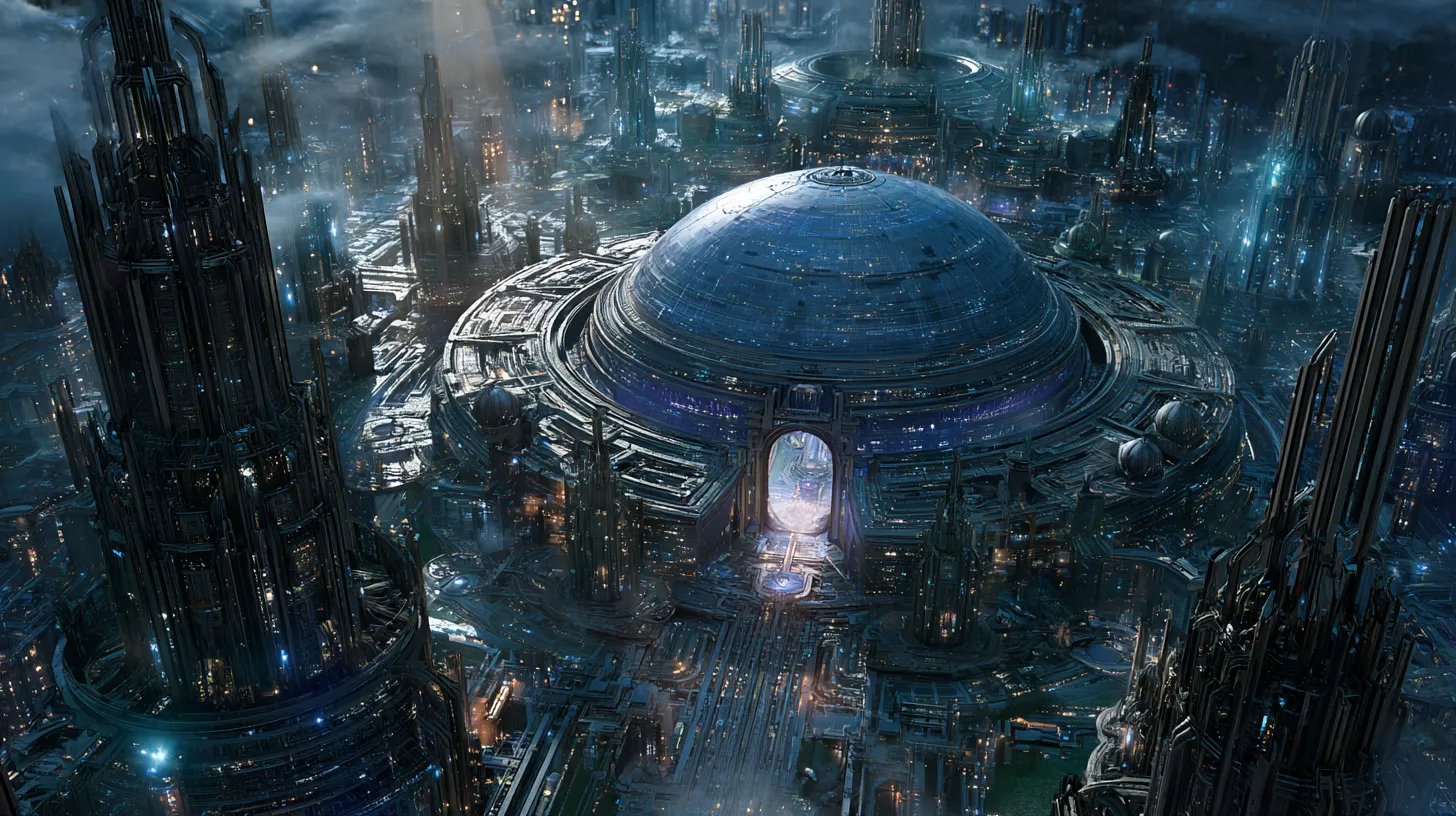
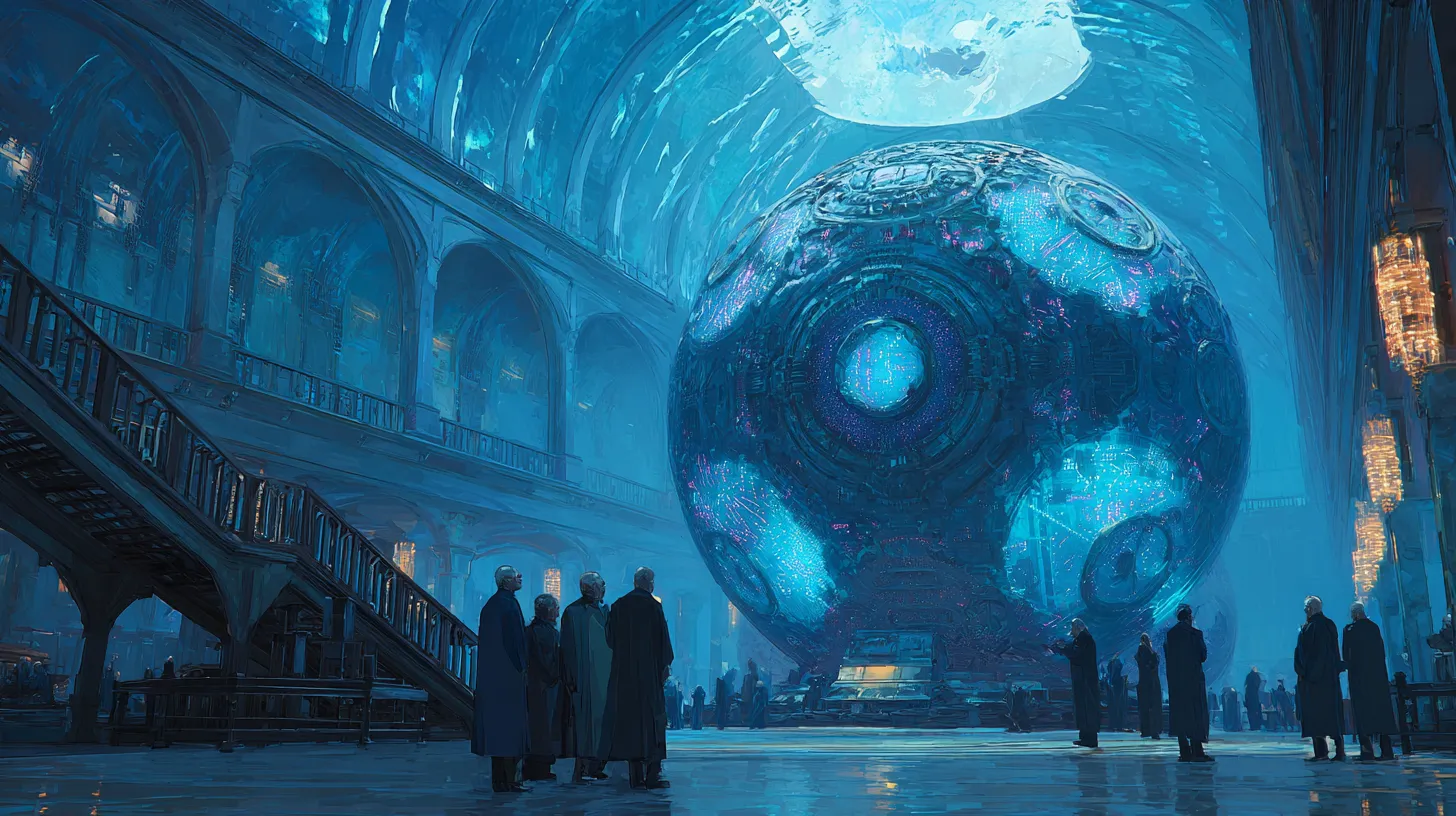
In 2021, Apple TV+ launched a television adaptation of the Foundation series, developed by David S. Goyer and Josh Friedman. The show expanded Asimov's ideas considerably — adding the Genetic Dynasty of Emperor Cleon (not in the books), gender-swapping key characters like Gaal Dornick and Salvor Hardin, and visualizing concepts like Trantor and the Vault in spectacular detail. As of April 2026, three seasons have aired, covering material from Foundation through Second Foundation, with the Mule arc forming the climax of Season 3.
Honors and Recognition
Asimov's trophy shelf reflects both the volume and the durability of his work. The Foundation trilogy won the one-time Hugo Award for Best All-Time Series in 1966 — famously beating J.R.R. Tolkien's The Lord of the Rings, the only time the award was ever given. His novel The Gods, Themselves (1972) won both the Nebula Award and the Hugo Award for Best Novel, and his novelette "The Bicentennial Man" (1976) took home both awards as well. In 1987, the Science Fiction Writers of America named him its eighth Grand Master, honoring a lifetime of achievement. His name now sits on an asteroid, a Martian crater, a Brooklyn public school, and a science fiction magazine that has published continuously since 1977.
Common Misconceptions About Asimov
"Asimov predicted the internet and AI." He anticipated broad patterns more often than specific gadgets. His 1951 story "The Fun They Had" imagines children schooled at home by mechanical teachers — a striking image of automated, remote learning — but Asimov was always a better explainer of present-day science than a prophet of particular inventions. Treating him as a fortune-teller undersells what he actually was: the great popularizer of scientific thinking.
"The Three Laws are a real engineering standard." Asimov designed the Laws as narrative devices — a seemingly airtight ruleset whose hidden paradoxes generate stories. No robotics lab implements them, and real AI safety research tackles problems Asimov never tried to solve, from training-data bias to alignment. The Laws' true legacy is giving generations of engineers and ethicists a shared vocabulary for discussing machine behavior.
"He planned the Foundation universe from the start." Nothing could be further from the truth. The original Foundation stories were written as standalone pieces for Astounding in the 1940s; the Robot novels and Empire novels were separate projects entirely. The grand unification — stitching three series into one 20,000-year future history around R. Daneel Olivaw — was a retrospective act of the 1980s, driven as much by his publisher's enthusiasm as by any master plan.
"Asimov only wrote science fiction." Science fiction was a minority of his output. The majority of his 500-plus books are nonfiction: guides to physics, chemistry, biology, and mathematics, plus histories of Greece and Rome, commentaries on Shakespeare and the Bible, and several volumes of memoir and humor.
Frequently Asked Questions
How many books did Isaac Asimov write?
Isaac Asimov wrote or edited more than 500 books across virtually every subject area. His fiction alone includes over 50 novels and hundreds of short stories, spanning the Foundation, Robot, and Empire series as well as standalone works.
What is the Foundation series about?
The Foundation series follows mathematician Hari Seldon's plan to shorten a predicted 30,000-year dark age to just 1,000 years after the fall of the Galactic Empire. Using "psychohistory" — a fictional science combining statistics, history, and sociology — Seldon establishes two Foundations to preserve knowledge and guide humanity's recovery.
Did Isaac Asimov invent the Three Laws of Robotics?
Yes. Asimov first articulated the Three Laws of Robotics in his 1942 short story "Runaround," published in Astounding Science Fiction. He credited editor John W. Campbell with helping refine the concept, though Asimov did the actual writing. The Laws remain the most influential framework for robot ethics in fiction.
Why did Asimov connect his Robot and Foundation series?
In the 1980s, Asimov's publishers encouraged him to return to his most popular series. Rather than write simple sequels, Asimov chose to unify his Robot, Empire, and Foundation novels into a single future history. He accomplished this primarily through the character of R. Daneel Olivaw, whose 20,000-year lifespan provided the connecting thread across all three series.
Is there a Foundation TV show?
Yes. Apple TV+ premiered its Foundation adaptation on September 24, 2021. Developed by David S. Goyer, the show takes significant creative liberties with the source material while preserving Asimov's core themes. As of April 2026, three seasons have been produced, adapting material through Second Foundation.